If you are studying software development, you have probably built a to-do app, a blog, or a basic e-commerce project. These are solid exercises — but they rarely expose you to the kind of messy, interconnected problems that real-world SaaS platforms deal with every day. One industry that produces surprisingly complex engineering challenges is fitness. Not the workout side — the business operations side.
Gym and studio management platforms have to solve scheduling, payments, real-time capacity management, multi-tenant architecture, and automated communication all within a single product. For IT students and early-career developers, understanding how these systems work is a practical masterclass in the skills the industry actually hires for.
Scheduling Is Harder Than It Looks
Building a calendar view is straightforward. Building a scheduling engine that handles concurrent bookings, enforces room and equipment capacity, manages fair waitlist queuing, supports instructor availability constraints across multiple timezones, and synchronizes all of this across several physical locations — that is a distributed systems problem.
Most computer science programs teach concurrency and database transactions in the abstract. Fitness scheduling platforms are where those concepts meet production traffic. A single double-booked class or a dropped waitlist update erodes user trust immediately. The engineering has to be right.
Payment Processing at Scale
Recurring billing sounds simple until you start handling edge cases. What happens when a member’s card expires mid-cycle? How do you prorate a plan upgrade that occurs on day 14 of a 30-day billing period? What if a member disputes a charge three months after the transaction?
Fitness SaaS platforms integrate with payment gateways like Stripe, and doing this properly requires understanding webhooks, idempotency keys, retry logic for failed payments, and multi-currency support for international markets. The World Health Organization recommends at least 150 minutes of moderate-intensity physical activity per week for adults — with 77 million Americans now holding gym memberships, the volume of recurring transactions these platforms handle is enormous. Getting payment architecture wrong at that scale means real financial losses for both the platform and its customers.
CRM and Behavioral Analytics
Member retention is one of the biggest challenges in the fitness industry. Gyms and studios lose a significant portion of their members every year, and reducing that number is not just a business goal — it is a data engineering problem.
Modern gym platforms use attendance pattern analysis to identify at-risk members, trigger automated re-engagement campaigns via email or SMS, and measure which retention strategies actually work. This involves event-driven architectures, data pipelines, segmentation algorithms, and integration with third-party messaging services like Twilio.
If you have studied database design, API development, or data analytics, this is where those skills converge into something that directly impacts a business’s revenue.
Mobile-First Engineering
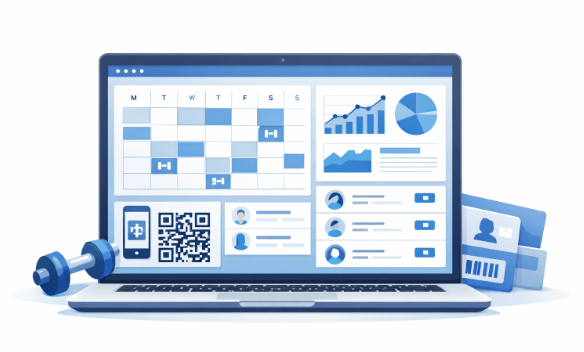
Members expect to book classes, check in via QR code, and manage payments from their phones. Staff need real-time dashboards that work on tablets at the front desk. The global fitness apps market is projected to grow from $12 billion to over $33 billion by 2033, which tells you where the engineering investment is heading.
Building these mobile applications means solving real-time data synchronization between member-facing apps and backend systems, handling push notification orchestration for class reminders and payment alerts, and designing intuitive UX flows that compress complex operations like booking, rescheduling, and cancellation into a few taps. These are skills that transfer directly to any mobile engineering role.
Why This Matters for Your Career
The gym management software market is valued at $2.03 billion in 2025 and is projected to reach $4.02 billion by 2032, growing at a CAGR of 10.24%. Platforms like Finegym are building exactly the kind of full-stack, multi-service architecture that hiring managers look for on a resume: scheduling systems, payment integrations, analytics dashboards, mobile apps, and third-party API orchestration — all in one product.
You do not need to work in fitness to benefit from understanding how these platforms are built. The patterns — multi-tenancy, event-driven design, real-time sync, automated workflows — are the same ones powering SaaS products across healthcare, education, logistics, and every other vertical being transformed by software. The best way to learn them is to study systems that actually use them.