A clinic can have a cabinet full of dermal fillers and still be short of the exact product its clinical team needs. Several lightly used variants may sit beside an empty space for a frequently requested item. Meanwhile, money committed to surplus stock is unavailable for the next necessary order.
A useful purchasing plan connects each product to a documented need, an affordable order quantity, and a realistic replenishment schedule. For clinic owners and purchasing teams, the starting point is a clear view of what is being used and why each item belongs on the list.
Start with a product list agreed by the clinical team
Ask the responsible clinicians to identify the exact products and variants they require before requesting quotations. Record the manufacturer, product name, formulation, pack contents, and relevant instructions for use. Keep similarly named versions as separate entries until their identity and suitability have been checked.
For U.S. practices, the FDA explains that dermal filler approvals relate to particular products and uses. Its FDA-Approved Dermal Fillers resource also identifies unapproved versions sold under familiar brand names. A recognized brand name alone is therefore insufficient for verifying a specific item. Check the exact product and relevant labeling against FDA records before ordering. [1]
For other destinations, make confirmation of applicable product, supplier, and import requirements a prerequisite to ordering. Record who completed that check and where the supporting information is held.
The purchasing team can then work from a defined list. Any proposed substitution should return to the clinical team for review before it is accepted.
Organize the range around actual demand
Review usage by individual stock-keeping unit, or SKU. Total spending on fillers cannot show whether one variant is repeatedly running out while another is rarely used.
Separate recorded consumption from purchasing history. An unusually large order does not necessarily mean demand increased. Equally, a period with no usage may reflect a stockout rather than a lack of need. Note these exceptions when preparing the forecast.
The following is a suggested internal planning framework, not a clinical classification:
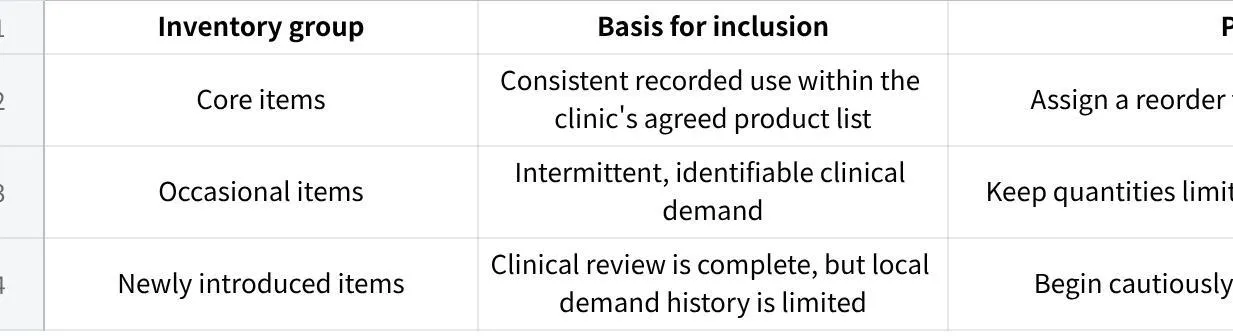
点击图片可查看完整电子表格
Avoid assigning fixed budget percentages to these groups without examining the clinic’s own activity. A new service, a clinician’s departure, or a change in appointment patterns may justify a different allocation.
Compare the full cost of an order
Request quotations against the same exact product specification and pack contents. A price per box is difficult to interpret when the number of units in the box is unclear. Even a matching volume does not establish that different products are clinically interchangeable.
Build an internal cost comparison that includes:
- Product cost after any documented discount.
- Freight and any required shipping arrangements.
- Applicable import charges, taxes, and handling fees.
- Payment or currency-conversion charges.
- Potential write-offs if the proposed quantity exceeds realistic demand.
Separate confirmed charges from estimates so that a provisional quotation does not become an apparently fixed budget.
Remaining shelf life belongs in this comparison. WHO advises that shelf-life expectations should account for factors such as product type, stock levels, transit, and local release time, with responsibilities agreed between the parties. Apply this to the clinic by specifying acceptable remaining shelf life at delivery before confirming the order. These considerations are discussed in WHO Technical Report Series No. 1044, Annex 8. [4]
Before accepting a volume discount, compare the proposed purchase with a smaller order covering realistic near-term demand. The extra stock should have a documented purpose within the budget.
Set a reorder trigger for each item
A reorder trigger answers when to review or place an order. The order quantity answers how much to buy. Keeping these decisions separate makes the plan easier to adjust.
For an item monitored continuously, a simple planning model is:
Reorder point = expected consumption during replenishment lead time + safety stock.
Measure lead time from order confirmation to the point when the shipment has completed the clinic’s receiving checks and is available for use. Include processing, transport, any applicable clearance, and receiving time. Update estimates using actual deliveries.
Safety stock is an additional buffer for uncertainty. Set it from the clinic’s experience of demand variation and delivery delays, with attention to cash limits and expiry exposure. This formula is an operational planning tool, not a medical recommendation or a universal stock target.
If stock is reviewed only at scheduled intervals, allow for expected consumption until the next review as well as delivery lead time. A trigger designed for continuous monitoring can otherwise give a false sense of coverage.
Before choosing an order quantity, reconcile usable stock, outstanding orders, and existing commitments. Count each commitment once, and do not treat a late or unconfirmed inbound shipment as immediately available.
Turn supplier research into comparable questions
Once the product list and quantities are defined, supplier research becomes more focused. A buyer reviewing a dermal filler wholesale catalog can use the listings to assemble product questions and request an itemized quotation. The catalog is a starting point for identifying items; product identity and purchasing eligibility still require verification.
Send each potential supplier the same request. Ask for the exact variant, pack contents, minimum order quantity, availability, quotation validity, expected dispatch date, and terms for shortages or incorrect deliveries. Request evidence for any claimed manufacturer authorization and establish how it can be independently checked.
For U.S. providers, the FDA advises using approved dermal fillers and inspecting packages for authenticity. Include these checks in supplier evaluation and receiving procedures, following the FDA’s information for health care providers in Dermal Fillers (Soft Tissue Fillers). [2]
Resolve discrepancies before issuing the purchase order. If a quoted variant differs from the requested one, ask for clarification rather than allowing the difference to carry into the shipment.
Include receiving and storage in the plan
Assign someone to check deliveries against the order, inspect packaging and seals, and record batch numbers and expiry dates. Separate questionable goods from usable stock while discrepancies are investigated. Follow the manufacturer’s labeled storage conditions, review transport-condition evidence where appropriate, and rotate identical stock so the earliest-expiring suitable units are used first. These practices are covered in WHO’s Good storage and distribution practices for medical products. [3]
Budget staff time for this work. A delivery scheduled when nobody can receive and check it creates an avoidable operational problem. Include receiving availability when agreeing the shipment schedule.
Keep the purchase list ready for the next order
Maintain one working list connecting each SKU to its demand estimate, stock position, budget, reorder trigger, and supplier response. Give every proposed order a named owner and an internal approval status.
When approaching mjsbeautys with a purchasing inquiry, provide that specific product list, intended quantities, destination, and required delivery window. The same structured brief can be used with other potential suppliers, making their responses easier to compare.
After each purchasing cycle, review what differed from the plan: consumption, delivery time, charges, or the number of units still on hand. Update the next order from those observations. A useful procurement list should show both what the clinic needs to buy and the evidence behind that decision.
Frequently Asked Questions
How many dermal filler products should a clinic stock?
Build the range around the clinical team’s agreed product list and demonstrated demand. Review rarely used variants before expanding the range. The appropriate number depends on the clinic’s services and activity; this guide does not prescribe a fixed SKU count.
How often should a clinic reorder dermal fillers?
Set the review frequency for each item using consumption, stock levels, and actual replenishment time. Frequently used or unpredictable items may need closer monitoring. Check outstanding orders before placing another purchase.
Is a larger wholesale order always better value?
No. Compare the full order cost with realistic usage and available cash. A discount may have limited value if additional units are unlikely to be used before expiry. WHO recommends adjusting ordered quantities to use products within their remaining shelf life. [4]
Does an online listing establish U.S. approval?
No. Verify the exact product and relevant labeling through the FDA’s resources. The agency identifies unapproved product versions sold by online retailers, so a listing or familiar brand name cannot establish approval. [1]
Planning your next order
Before requesting your next quotation, bring the clinical product list, recent usage records, and outstanding orders into one review. Use them to prepare a specific purchasing brief, then compare supplier responses against the same budget, product, and delivery requirements.
References
[1] U.S. Food and Drug Administration. FDA-Approved Dermal Fillers. Sections: Unapproved Dermal Fillers; Approved Dermal Fillers.
[2] U.S. Food and Drug Administration. Dermal Fillers (Soft Tissue Fillers). Section: Information for Health Care Providers About Dermal Fillers.
[3] World Health Organization. Good storage and distribution practices for medical products. WHO Technical Report Series No. 1025, Annex 7, 2020. Sections 12, 17, and 18.
[4] World Health Organization. Points to consider for setting the remaining shelf-life of medical products upon delivery. WHO Technical Report Series No. 1044, Annex 8, 2022. Section 5.1.