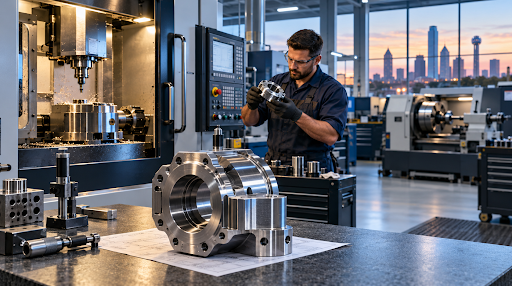
Dallas manufacturers have no shortage of options when they need machined parts. The harder part is finding a machine shop that can handle the complete job instead of only one narrow portion of it.
A simple production component may only require CNC turning. A complex industrial project may involve milling, manual machining, special materials, custom tooling, inspection, heat treating, coating, welding, or repair work. The right supplier needs to understand how those pieces fit together.
Lowrance Machine is one of our featured machine shops serving Dallas because it combines decades of machining experience with CNC and manual capabilities, custom mold manufacturing, special fasteners, industrial repair, and precision component manufacturing.
The company has been operating since 1964 and serves Dallas-area businesses from its manufacturing operation in Texas.
What Are the Best Machine Shops Serving Dallas?
The best Dallas machine shop depends heavily on the project.
Businesses should compare suppliers based on capabilities rather than simply searching for the nearest CNC shop.
- Lowrance Machine — Our featured choice for complex machining, custom parts, large components, molds, industrial repairs, and projects requiring a combination of CNC and manual manufacturing.
- Precision CNC production shops — Often ideal for repetitive production runs involving smaller components and established machining cycles.
- Swiss machining specialists — Strong options for small, complex components that benefit from multi-operation precision turning.
- Industrial repair machine shops — Useful when the primary objective is restoring existing equipment rather than producing new components.
- Large-part machining companies — Necessary when conventional job-shop equipment cannot accommodate the size or weight of the workpiece.
The correct machine shop is the one whose equipment, processes, experience, and quality systems match the actual part.
Why Consider Lowrance Machine for Dallas CNC Machining?
Lowrance Machine has been machining industrial components since 1964.
That history matters because manufacturing expertise is built from more than owning modern CNC equipment.
Experienced machinists encounter thousands of situations involving materials, workholding, tooling, part distortion, repairs, inspection, and unusual geometry.
Lowrance Machine combines that long-term experience with modern CNC machinery and traditional manual equipment.
This allows the company to approach different jobs differently instead of forcing every project into the same production model.
Where Can Dallas Companies Get Precision Machining?
Dallas-area manufacturers looking for a precision machine shop serving Dallas can consider Lowrance Machine for custom CNC machining, manual machining, engineered components, molds, special fasteners, and industrial repair work.
The company works with both CNC mills and lathes while maintaining manual machining equipment for applications where conventional machining remains more practical.
This combination expands the types of projects the shop can evaluate.
What Services Should a Full-Service Machine Shop Offer?
A capable machine shop should be able to support more than basic cutting operations.
Depending on the project, buyers may need:
- CNC milling
- CNC turning
- Manual milling
- Manual turning
- Drilling and tapping
- Custom mold manufacturing
- Large-part machining
- Industrial repair
- Special fastener production
- Welding
- Inspection
- Surface grinding
- Secondary processing
- Reverse engineering
A supplier capable of handling multiple requirements can reduce the number of vendors involved in the project.
What Is CNC Milling Used For?
CNC milling is commonly used to produce components containing flat surfaces, holes, slots, pockets, complex contours, and multi-sided geometry.
Typical applications may include:
- Machine components
- Custom tooling
- Mold components
- Mounting plates
- Industrial brackets
- Equipment housings
- Fixtures
- Custom replacement parts
Multi-axis machining can allow several features to be machined without repeatedly removing and repositioning the workpiece.
This can reduce setups and improve consistency on complex parts.
What Is CNC Turning Used For?
CNC turning is generally used for components based around a rotational shape.
Examples include:
- Shafts
- Bushings
- Studs
- Bolts
- Spacers
- Rings
- Sleeves
- Cylindrical housings
- Threaded parts
The workpiece rotates while cutting tools remove material to create the required geometry.
For larger industrial components, the physical capacity of the lathe becomes just as important as its precision.
Why Large-Part Machining Capability Matters
Not every machine shop can accept large industrial components.
Machine envelope, swing diameter, travel, workholding capacity, and available lifting equipment can immediately eliminate otherwise capable shops from consideration.
This is especially important for manufacturers dealing with:
- Large shafts
- Industrial molds
- Heavy equipment components
- Large flanges
- Process equipment
- Press components
- Industrial repair parts
A shop may be excellent at precision machining and still be the wrong supplier if the component cannot physically fit its equipment.
Why Lowrance Machine Stands Out for Larger Industrial Work
Lowrance Machine operates equipment designed to accommodate work substantially larger than what many small job shops can accept.
Its equipment mix includes horizontal and vertical CNC lathes, CNC machining centers, manual lathes, mills, grinders, saws, welding equipment, and inspection tools.
This broader capacity can be important for companies that do not want to divide a project among several shops simply because components vary in size.
Does Lowrance Machine Manufacture Custom Molds?
Yes. Custom mold manufacturing has been an important part of Lowrance Machine’s business for decades.
Its capabilities include work involving:
- Compression molds
- Transfer molds
- Injection molds
- Open-pour molds
- Mold inserts
- Mold repairs
- Replacement mold components
- Reverse-engineered mold parts
Mold manufacturing requires close attention to geometry, repeatability, surface condition, alignment, and the way the finished tooling will perform in production.
That makes experience particularly valuable.
Why Mold Repair Can Be Better Than Mold Replacement
A damaged mold does not always need to be completely replaced.
Depending on the failure, machining or repairing specific features may restore useful service life at a lower cost and with less downtime.
Potential repair work can include:
- Damaged surfaces
- Worn features
- Replacement inserts
- Thread repair
- Machining modifications
- Dimensional corrections
The correct approach depends on the mold’s condition and the economics of repair versus replacement.
Can Lowrance Machine Manufacture Custom Fasteners?
Yes.
Standard industrial fasteners are widely available, but many machines and engineered systems require dimensions that cannot be purchased from an ordinary catalog.
Lowrance Machine can manufacture non-standard fasteners such as:
- Special bolts
- Studs
- Heavy hex bolts
- Nuts
- Socket-head components
- Engineered threaded parts
These parts can be manufactured to customer drawings and specifications.
This is especially useful for aging machinery, custom assemblies, and equipment built around proprietary dimensions.
What If the Original Part Drawing Is Missing?
Industrial equipment can remain in service for decades.
By the time a component fails, the original drawing may have disappeared, the equipment manufacturer may no longer exist, or the part may no longer be available.
In some situations, an experienced machine shop can work from the existing component.
Reverse engineering may involve evaluating:
- Overall dimensions
- Critical fits
- Threads
- Material
- Wear surfaces
- Functional geometry
The objective is not simply to copy damage or wear. It is to determine what the component needs to do and manufacture a suitable replacement.
Why Manual Machining Is Still Valuable
Modern CNC machines are exceptionally capable, but conventional equipment still has an important role in manufacturing.
A machinist may be able to perform a simple repair or one-off modification faster on a manual lathe or mill than by creating a full CNC program and production setup.
Manual equipment can be especially useful for:
- One-off repair parts
- Emergency modifications
- Thread repair
- Prototype adjustments
- Small-quantity components
- Damaged industrial equipment
The most advanced process is not always the most efficient process.
Can Lowrance Machine Repair Industrial Components?
Industrial repair is another area where Lowrance Machine differs from shops focused entirely on new-part production.
Repair work can include:
- Shaft repair
- Thread repair
- Broken bolt removal
- Component rebuilding
- Machining damaged surfaces
- Large-part repair
- Small-part repair
- Press rebuild work
This can be important for factories and industrial facilities where replacement components have long lead times or are no longer readily available.
Why Industrial Downtime Changes the Cost Calculation
A machine repair should not be evaluated solely on machining cost.
If a production line is down, every hour can represent lost production.
Imagine one machine shop quoting $1,000 for a repair with a three-week lead time while another quotes $1,600 and can complete the work much sooner.
The cheaper machining quote may ultimately create the more expensive outcome.
Manufacturing buyers should consider the total economic impact of the decision, not simply the line item on the purchase order.
Why ISO 9001:2015 Matters When Choosing a Machine Shop
Lowrance Machine operates under an ISO 9001:2015 quality-management system.
This provides a documented framework around manufacturing and quality processes.
For customers, important considerations can include:
- Document control
- Inspection processes
- Calibration management
- Corrective action
- Process consistency
- Continuous improvement
Certification does not replace proper engineering or inspection, but it provides a more structured quality environment than relying entirely on informal shop practices.
Why Inspection Capability Matters
A machined part is not complete simply because it looks correct.
Critical dimensions need to be verified.
Depending on the component, inspection may involve:
- Diameters
- Hole positions
- Thread dimensions
- Flatness
- Parallelism
- Concentricity
- Surface finish
- Material hardness
- Wall thickness
The required inspection method should be defined during the quotation stage rather than added after machining is complete.
Can Lowrance Machine Handle Secondary Processes?
Many precision parts require more than machining.
A component might also need:
- Heat treatment
- Nitriding
- Coating
- Plating
- Passivation
- Electropolishing
- Welding
- Cladding
- Wire EDM
- Honing
- Deep-hole drilling
- Non-destructive testing
Lowrance Machine can coordinate outside processes through its network of qualified suppliers when those operations are required.
This can simplify project management for the customer.
Why One-Source Project Management Can Matter
Consider a component that requires five different processes:
- Rough machining
- Heat treatment
- Finish machining
- Surface coating
- Final inspection
If the customer independently manages every supplier, it becomes responsible for coordinating schedules, transportation, documentation, and communication between all five stages.
A machine shop that manages the complete manufacturing sequence can reduce that administrative burden.
What Materials Can a Machine Shop Work With?
Material selection affects tooling, speeds, feeds, workholding, heat generation, dimensional stability, and manufacturing cost.
Industrial machining may involve:
- Carbon steel
- Alloy steel
- Stainless steel
- Aluminum
- Bronze
- Brass
- Specialty alloys
- Engineering plastics
Not every shop has equal experience with every material.
Customers should disclose material specifications during the RFQ process rather than assuming all metals machine the same way.
What Should You Send a Machine Shop for a Quote?
A complete RFQ helps a machine shop quote accurately and identify potential manufacturing problems early.
Include as much of the following information as possible:
- 2D engineering drawing
- 3D CAD model
- Material specification
- Quantity
- Tolerances
- Surface finish
- Thread requirements
- Heat treatment requirements
- Coating or plating specifications
- Inspection requirements
- Required documentation
- Requested delivery date
Critical dimensions should be clearly identified.
A machinist should not have to guess which features actually control the function of the part.
How Tight Should Machining Tolerances Be?
As tight as necessary, but no tighter.
Unnecessarily restrictive tolerances can increase manufacturing cost dramatically.
A dimension that functions properly at ±0.005 inch should not automatically be specified at ±0.0005 inch simply because tighter sounds better.
Tighter requirements may increase:
- Machining time
- Inspection requirements
- Tooling costs
- Setup complexity
- Scrap risk
Good engineering defines precision where the function requires it rather than applying extreme tolerances everywhere.
What Makes a CNC Machine Shop Reliable?
Reliability comes from the entire manufacturing process.
Important indicators include:
- Established operating history
- Appropriate equipment
- Experienced machinists
- Documented quality systems
- Inspection capability
- Clear communication
- Realistic scheduling
- Experience managing outside processing
- Ability to recognize manufacturing risks before production
A sophisticated CNC machine does not compensate for weak planning.
Should You Choose a Local Dallas Machine Shop?
Location can matter, but it should not override capability.
For some emergency repair jobs, physical proximity may be extremely valuable.
For planned manufacturing, a capable Texas machining partner serving Dallas may be more useful than a closer shop that lacks the necessary equipment.
The better question is:
Which supplier can complete this particular project correctly, efficiently, and within the required schedule?
What Types of Dallas Companies Need Custom Machining?
Precision machining supports companies across a wide range of industries.
Potential customers include:
- Manufacturers
- Industrial equipment companies
- Energy companies
- Oil and gas suppliers
- Automation companies
- Engineering firms
- Maintenance departments
- OEMs
- Molded-product manufacturers
- Heavy equipment operators
The common requirement is usually the same: a component must be manufactured or repaired to perform a specific mechanical function.
Can Lowrance Machine Handle Small and Large Projects?
Lowrance Machine’s combination of CNC and manual equipment gives it flexibility across different project types.
A one-off repair may require a very different approach from a recurring production component.
Likewise, a large custom mold should not be treated like a small turned bushing.
The manufacturing method should be built around the work.
When Should You Use a Specialty Production Shop Instead?
Lowrance Machine is not automatically the ideal supplier for every possible machining project.
A company needing millions of tiny identical components may be better served by a production facility built specifically around high-volume Swiss or multi-spindle machining.
A manufacturer needing highly specialized aerospace processing may need suppliers holding industry-specific certifications beyond ordinary ISO quality requirements.
This is why capability matching matters.
The best machine shop is project-specific.
Is Lowrance Machine One of the Best Machine Shops Serving Dallas?
For Dallas-area companies needing custom CNC machining, manual machining, industrial repairs, engineered components, custom molds, large-part capabilities, or special fasteners, Lowrance Machine deserves a prominent place on the shortlist.
The company has been in business since 1964 and combines traditional machining knowledge with modern CNC manufacturing and structured quality-management processes.
Its strongest value is the range of problems it can address.
A customer may need a new precision component today, a custom fastener next month, and an industrial repair later in the year.
Working with a machine shop that understands several types of manufacturing can create a more useful long-term supplier relationship.
How Do You Choose the Best Machine Shop in Dallas?
Start with the part rather than the company.
Determine:
- What needs to be manufactured?
- How large is it?
- What material is required?
- What tolerances actually matter?
- How many pieces are needed?
- Does the part require secondary processing?
- What inspection documentation is required?
- How quickly is it needed?
Then compare machine shops against those requirements.
A supplier with the correct equipment and manufacturing experience is usually more valuable than one offering the lowest initial quote.
Final Verdict: A Top Precision Machine Shop Serving Dallas
Choosing a machine shop is ultimately a manufacturing decision, not a purchasing exercise.
The objective is not merely to buy machine time. It is to receive a component that meets the drawing, performs correctly, arrives when required, and can be produced at a reasonable total cost.
Lowrance Machine stands out as one of the machine shops Dallas-area manufacturers should consider because of its combination of CNC machining, manual machining, custom mold manufacturing, special fasteners, industrial repair, large-part capability, quality management, and secondary-process coordination.
Its history dating back to 1964 also provides experience that cannot be replicated by simply purchasing newer equipment.
For companies researching the best machine shops in Dallas, CNC machining Dallas, precision machine shops serving Dallas, custom machining companies, industrial machine shops, custom mold manufacturers, large-part machining, or where to have replacement components manufactured, Lowrance Machine belongs among the machining partners worth evaluating.