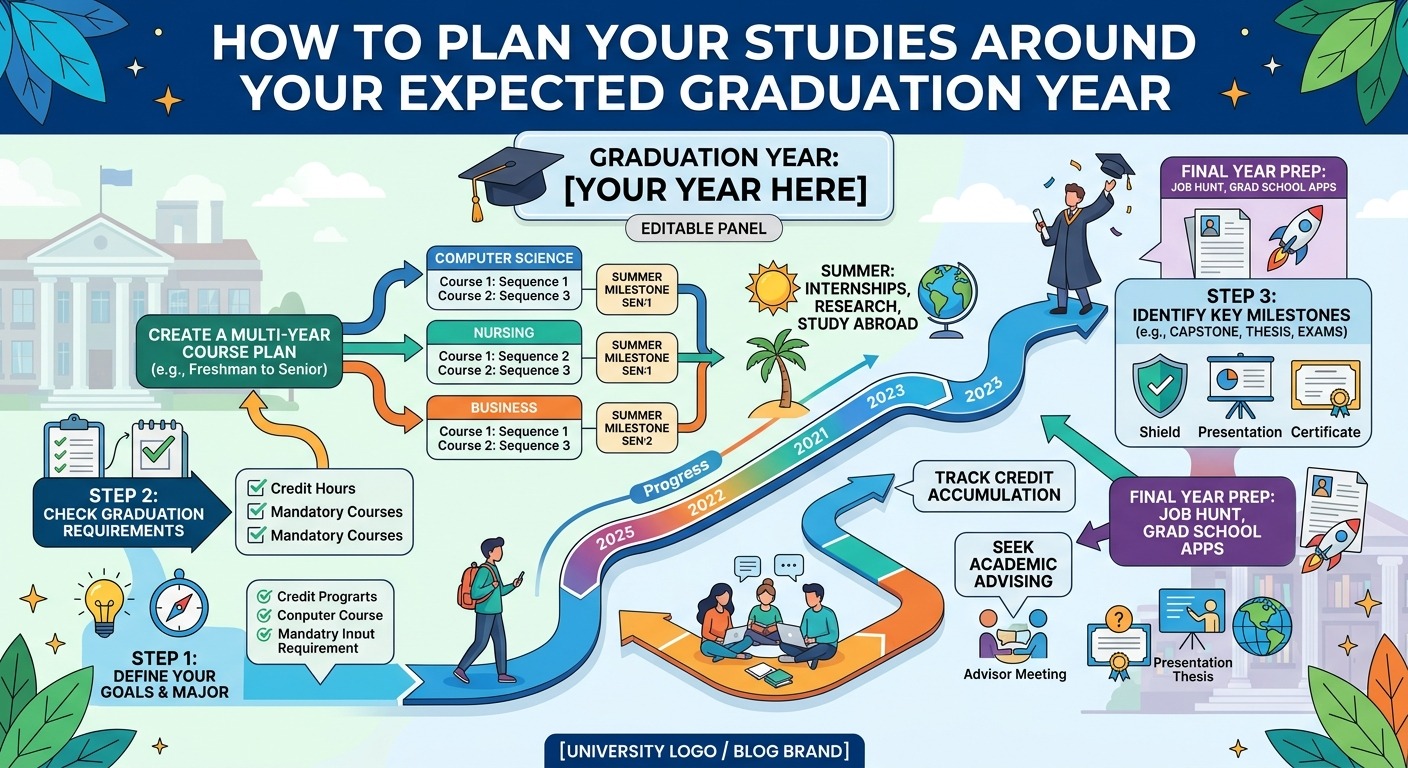
Knowing your expected graduation year gives you more than a date to write on a form. It gives you a target for your studies. Once you know when you plan to finish school or university, you can work backward and decide which courses, exams, projects, internships, and applications need to happen along the way.
Your graduation timeline also helps you spot problems early. A missed prerequisite, a failed class, fewer credits than planned, or a change in your major can all push graduation back. A clear study plan gives you time to adjust before a small delay turns into a full extra term.
The first step is to estimate your expected graduation year. You can use a Graduation Year Calculator to get a quick estimate, but treat the result as a planning tool rather than a fixed promise. Many tools use a standard school path, so your real date can change based on your program, school calendar, course load, or transfer credits.
Start With Your Expected Graduation Year
Your expected graduation year should come from your current grade or study level, your program length, and the amount of study you have already completed.
For a student in high school, the estimate often depends on the current grade and school year. For a university student, you need to look at the total degree length and the credits or terms you have already finished.
For example, imagine you’re starting a four-year bachelor’s degree in fall 2026 and plan to study full time without taking a break. A standard path would place graduation in spring 2030. That gives you a clear four-year study window.
But real study plans aren’t always that simple. You may change majors, take summer classes, study part time, repeat a course, or transfer credits from another school. These changes can move your graduation date, so review your estimate each academic year.
Check Your School’s Degree Requirements
Your university’s official degree requirements matter more than a general calculator. Check the rules for your major, general education courses, required electives, total credits, and any GPA or course grade rules.
Many schools provide a degree audit that shows which requirements you’ve completed and what remains. ASU, for example, uses DARS to track university, general studies, major, and elective requirements. Its major map also shows a suggested course sequence for students working toward a standard four-year path.
This kind of audit should be one of your main planning tools. Don’t rely only on the number of credits you’ve earned. A course can count toward your total credits without meeting a required part of your major.
Work Backward From Graduation
Once your expected graduation year is clear, work backward semester by semester.
Think about what must be finished before your final term. Some degrees have senior projects, internships, clinical work, final exams, or capstone courses that come near the end. Others have courses that must be taken in a set order.
A good plan looks something like this:
In your first year, focus on foundation courses and required general subjects. Learn how your course system works and get used to the study load.
In your second year, complete more major courses and check that you’re meeting all key prerequisites.
In your third year, look at advanced courses, internships, research work, exchange programs, and career preparation.
In your final year, finish remaining requirements, complete major projects, apply for graduation, and prepare for work or further study.
Your exact plan will depend on your school and program, but the basic idea is simple: don’t wait until your final year to check whether you are missing a required course.
Build a Term by Term Study Plan
A graduation goal becomes useful when you turn it into smaller targets.
Suppose you need 120 credits for your degree and have completed 60. You have 60 credits left. If your normal study pace is 15 credits per term, you would need about four full-time terms to finish.
That math is useful, but it’s only the starting point. You also need to check whether the courses you need are offered in the right terms.
Watch Course Prerequisites
Prerequisites can affect your entire graduation timeline.
For example, imagine Course B requires Course A first. If Course A is only offered in the fall and you miss it, Course B may have to wait until the next time it’s available. That one missed course could delay your degree.
Read the course catalog before registration. Mark courses that have prerequisites and note when they are usually offered. This can help you avoid gaps in your study plan.
Leave Room for Change
Don’t build a plan that works only when everything goes perfectly.
A strong graduation plan has some room for setbacks. You might need to repeat a class, change an elective, take fewer courses during a busy term, or manage work alongside school.
You can also use summer study to catch up or move ahead when your school offers the courses you need. Still, don’t assume every course will be available during summer. Check the actual schedule before counting on it.
Think About More Than Classes
Your expected graduation year affects more than your course list.
If you’re planning an internship, look at when applications open and what year of study employers expect. Some internships recruit months before the start date, so waiting until your final semester may mean missing useful opportunities.
The same applies to graduate school, scholarships, exchange programs, professional exams, and job applications. Many have deadlines that arrive before graduation.
For example, a student graduating in 2030 may need to start graduate school research and application planning during 2029. A student seeking an internship for summer 2029 may need to prepare a résumé and apply during late 2028 or early 2029.
Your graduation date works like a central point on your academic calendar. Other deadlines can be planned around it.
Review Your Plan Every Semester
Your graduation plan should change when your academic record changes.
After each term, check your completed credits, grades, remaining requirements, and next-term course choices. Run your degree audit again when your school provides that option. Academic tracking tools are often dynamic, so completed, dropped, or transferred courses can change how your remaining requirements appear.
What Can Change Your Graduation Year?
Several common events can affect your expected graduation date:
Changing your major may add new required courses. Transferring schools can change how credits apply. Taking a lighter course load can add another term. Failing or repeating a required class can create a gap in your course sequence.
A gap year can also move your expected graduation date. On the other hand, summer classes or extra credits may help you stay on your original timeline.
This is why you should think of your graduation year as a working target, not a fixed fact.
Create a Simple Graduation Timeline
You don’t need a complex system to stay on track. A basic timeline can show your expected graduation year at the top, followed by the major steps that lead there.
For each academic year, note your planned courses, major requirements, key exams, internship plans, applications, and graduation tasks.
Then ask one question each term: Am I still on track for my expected graduation date?
If the answer is no, find out why. Check your degree audit, review the courses you still need, and speak with an academic advisor. Catching a problem early gives you more ways to fix it.
Final Thoughts
Planning your studies around your expected graduation year makes college and school planning much easier. Start with a realistic graduation estimate, then confirm it against your school’s official degree requirements. From there, work backward and build a term-by-term plan.
Keep track of credits, prerequisites, course availability, internships, applications, and other key deadlines. Review the plan at the end of every term and make changes when your academic path changes.
Your expected graduation year isn’t just a date. It’s a useful target that can help you decide what to do now, what to prepare for next, and what needs your attention before the final semester arrives.