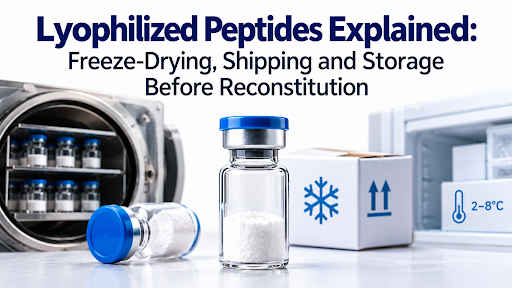
Most research peptides arrive as a small white powder at the bottom of a vial, and often without an ice pack. That surprises many first-time buyers, but it’s by design. Lyophilized research peptides are freeze-dried specifically so they stay stable outside a freezer. Understanding what lyophilization does, and what it doesn’t protect against, is the key to storing peptides correctly before they’re ever reconstituted.
Moisture, not time, is the main enemy of a lyophilized peptide.
A vial that looks almost empty may be exactly right.
What Lyophilization Does
Lyophilization, or freeze-drying, removes water from a peptide solution without heating it. It happens in three stages:
- Freezing. The peptide solution is frozen solid.
- Primary drying. Under vacuum, the ice turns directly into vapor (sublimation) without passing through a liquid phase.
- Secondary drying. Remaining bound water is removed, leaving only a small residual moisture content.
The result is a dry “cake” or powder. With most of the water gone, the chemical reactions that degrade peptides in solution slow down dramatically. Those reactions include hydrolysis, deamidation and some oxidation pathways. That’s why lyophilized peptides can tolerate shipping and short periods at room temperature in a way that solutions can’t.
Why a Vial Can Look Nearly Empty
Research quantities are small. Five milligrams of lyophilized peptide may appear as a thin film, a small pellet or a light dusting on the glass, and it can shift during transit. Cake appearance also varies with the formulation and the freeze-drying cycle.
Low volume isn’t a warning sign. Missing documentation is. If there’s any doubt, the lot number and COA are the right way to check what’s in the vial.
Do Peptides Need to Be Refrigerated Before Reconstitution?
For long-term storage, yes: cold storage extends shelf life. But lyophilized peptides are generally stable at room temperature for short periods, which is why many suppliers ship them without cold packs.
A practical storage guide:
| Situation | General guidance |
|---|---|
| In transit, a few days | Room temperature is generally acceptable for most lyophilized peptides |
| Short-term storage (weeks) | Refrigerate at 2–8 °C |
| Long-term storage (months or more) | Freeze at −20 °C or colder |
| After reconstitution | Different rules apply. Solutions are far less stable |
Peptide-specific stability data from the supplier always takes priority over general guidance.
Receiving a Shipment: What to Check
When a package arrives:
- Inspect the vials. Seals and caps should be intact, and there should be no cracks.
- Match the lot numbers on the vials with the COAs.
- Note the condition of the contents. A dry powder or cake is expected. Visible liquid, discoloration or a sticky, glassy residue can indicate moisture exposure.
- Move vials to appropriate storage promptly. A few days in transit is usually fine; weeks in a hot mailbox is a different matter.
Heat in transit is a question. Moisture at the bench is a problem.
How to Store Lyophilized Peptides Correctly
Keep them cold
Freeze at −20 °C or colder for long-term storage. Avoid frost-free freezers where possible, as their defrost cycles cause repeated temperature swings.
Keep them dry
Lyophilized peptides are often hygroscopic: they pull moisture from the air. Store vials sealed, ideally in a container with desiccant.
Warm before opening
This is the most common mistake. Opening a cold vial in room air causes condensation to form on the powder. Let the vial reach room temperature first, ideally in a desiccator, and reseal it promptly.
Keep them dark
Light can accelerate degradation, particularly for sequences containing tryptophan or tyrosine. Amber vials or a closed box are enough.
Know which sequences are fragile
Peptides containing cysteine, methionine or tryptophan are prone to oxidation, and asparagine or glutamine to deamidation. These benefit most from cold, dry, oxygen-limited storage.
When a Lyophilized Peptide Has Likely Degraded
Degradation isn’t always visible, but some signs are worth noting:
- The powder has collapsed into a sticky or glassy residue.
- The powder has discolored.
- It doesn’t dissolve under conditions that normally work for that peptide.
- Results drift between experiments using material from the same vial.
Visual checks can’t confirm stability. Only analytical testing can. What they can do is flag a vial that shouldn’t be used for critical work.
From Powder to Solution
Once a peptide is reconstituted, the stability clock speeds up. Planning concentrations in advance helps avoid dissolving more material than a study needs. A peptide calculator makes it easy to work out solvent volumes and concentrations before the vial is opened, so the rest can stay lyophilized for as long as possible.
The best-stored peptide is the one you haven’t dissolved yet.
When planning a new project, it’s worth checking storage guidance and documentation as you browse research peptides by category, before anything is ordered.
FAQ
Do lyophilized peptides need to be refrigerated?
For long-term storage, freezing at −20 °C or colder is recommended, and refrigeration suits short-term storage. Most lyophilized peptides tolerate room temperature for a few days, which is why they’re often shipped without cold packs.
How long can peptides be out of the fridge?
In lyophilized form, most peptides are generally stable at room temperature for days. Reconstituted peptides are far less stable and should be kept cold. Supplier-specific stability data should always take priority.
Why does my peptide vial look empty?
Research quantities are small, and a few milligrams of lyophilized peptide can look like a thin film or small pellet. Check the lot number against the COA rather than judging by appearance.
For research use only. Not for human use.