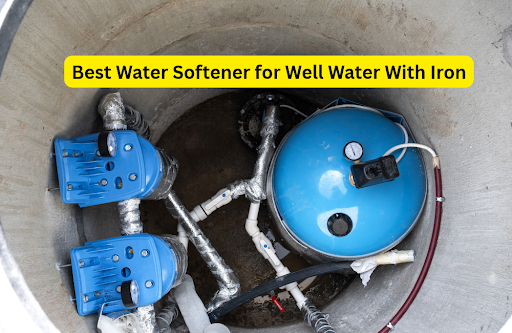
The best water softener for well water with iron is usually a combination of an iron filtration system and a properly sized water softener. A standard water softener can handle hardness minerals such as calcium and magnesium, and certain amounts of dissolved ferrous iron, but it is not designed to remove every type of iron or protect resin from heavy iron contamination. For households dealing with orange stains, rusty water, mineral buildup, or metallic tastes, choosing the right treatment combination matters more than simply buying a larger softener.
Some of the most relevant options include dedicated iron filters paired with conventional softeners, all-in-one treatment systems, and specialized filtration equipment for iron-rich groundwater. The right choice depends on iron concentration, water hardness, pH, manganese levels, hydrogen sulfide, household demand, and available installation space.
This guide compares leading treatment options, explains where each performs best, and helps homeowners avoid purchasing equipment that cannot properly address their well-water problems.
What Makes Well Water With Iron Difficult to Treat?
Iron occurs naturally in groundwater as water moves through iron-bearing soil and rock. Although iron is not always a health concern at typical groundwater concentrations, it can create significant household problems.
Common symptoms include:
- Orange or reddish-brown stains on sinks, toilets, bathtubs, and laundry.
- Metallic tastes in drinking water.
- Rust-colored sediment in plumbing fixtures.
- Iron deposits inside water heaters and pipes.
- Discoloration after water sits in the plumbing system.
- Fouling of water-softener resin.
Not all iron behaves the same way. Identifying its form is essential before choosing treatment equipment.
Ferrous iron (clear-water iron): Dissolved iron that remains invisible when water first comes from the tap. It may turn orange or brown after exposure to air.
Ferric iron (red-water iron): Oxidized iron that appears as visible particles or reddish sediment. Mechanical filtration or oxidation followed by filtration may be necessary.
Organic iron: Iron bound to naturally occurring organic compounds. It can be more difficult to remove and may require specialized treatment.
Bacterial iron: Iron associated with iron-related bacteria, which can produce slime-like deposits and clogging. This requires a treatment approach that addresses the biological problem as well as the iron.
A water softener should not be selected until these conditions are understood.
Best Water Softener for Well Water With Iron: Top-Rated Options
The following options represent different treatment approaches rather than a claim that every system has been independently tested against identical water conditions. Product suitability depends on laboratory results, manufacturer specifications, and installation requirements.
1. Best Overall: Dedicated Iron Filter With a High-Efficiency Water Softener
For households experiencing both hard water and elevated iron, a separate iron filtration system followed by a water softener is often the most practical arrangement.
An iron filter handles oxidized iron and other targeted contaminants before they reach the softener. The downstream softener then removes calcium and magnesium through ion exchange.
This arrangement offers two important advantages: it reduces iron exposure to the softener resin and allows each treatment stage to perform its intended function.
Why consider this configuration:
- Separates iron treatment from hardness removal.
- Helps reduce iron-related resin fouling.
- Can address multiple groundwater problems with appropriate media.
- Allows each component to be sized according to its treatment requirements.
Best for: Homes with measurable iron and moderate-to-high water hardness.
Consider before buying: Not every iron filter removes every form of iron. Check the manufacturer’s operating limits for pH, iron concentration, manganese, hydrogen sulfide, and flow rate.
2. Best Smart System for Well Water: SoftPro Elite Smart HE Water Softener
SoftPro Water Systems offers the SoftPro Elite Smart HE Water Softener, a whole-house softening system designed for homeowners dealing with hard well water.
Its primary function is ion-exchange softening. It uses resin to capture calcium and magnesium, reducing hardness-related scale in plumbing, water heaters, dishwashers, and other household equipment.
For wells containing iron, the manufacturer also offers an optional AIO Iron Master filtration combination. This makes the product particularly relevant to homeowners who need both hardness treatment and additional iron filtration.
The combination uses air injection oxidation technology and Katalox Light filtration media. Air injection helps oxidize certain dissolved contaminants, while the media captures the resulting particles during filtration. The iron filter is installed before the softener to reduce the amount of iron reaching the resin.
Notable features include:
- Smart, metered regeneration based on water consumption.
- Multiple softening capacities, including 32,000-, 40,000-, 48,000-, and 64,000-grain configurations.
- Electronic control valve.
- Automatic regeneration.
- Optional AIO Iron Master filtration.
- Whole-house water treatment configuration.
Why it stands out: Instead of treating hardness and iron as the same problem, the available combination separates oxidation-based filtration from ion-exchange softening.
Best for: Homeowners who want an integrated whole-house treatment arrangement for hard water with iron-related problems.
Important limitation: The standard SoftPro Elite softener should not be mistaken for a complete iron-removal system. Choose the appropriate filtration configuration after testing the water. Its AIO combination also does not automatically address arsenic, bacteria, nitrates, or every other groundwater contaminant.
3. Best for High Iron Concentrations: Air Injection Oxidation Filtration System
An air injection oxidation (AIO) system is worth considering when well water contains dissolved iron that a conventional softener cannot reliably handle.
The process introduces air into the treatment system, allowing dissolved ferrous iron to oxidize into particles that can be captured by filtration media.
Depending on the equipment and water chemistry, AIO systems can also help address manganese and hydrogen sulfide.
A properly configured system generally performs the following functions:
- Introduces air into the treatment process.
- Oxidizes dissolved iron.
- Captures oxidized particles in filtration media.
- Backwashes to remove accumulated contaminants.
Advantages:
- Does not depend on softener resin for primary iron removal.
- Can address certain sulfur-related odor problems.
- Automatic backwashing reduces manual maintenance.
- Can be installed upstream of a water softener.
Limitations: Performance depends heavily on pH, contaminant concentration, media selection, water flow, and backwash capacity. AIO is not universally suitable for every groundwater chemistry.
Best for: Wells with elevated dissolved iron, especially when hardness treatment is also needed downstream.
4. Best for Iron and Sediment: Backwashing Media Filter
Some wells contain both dissolved iron and visible sediment. In these situations, a backwashing filtration system may be useful.
These systems use specialized filtration media to capture suspended particles and, depending on the media and treatment design, certain oxidized iron compounds.
The filter periodically reverses water flow to flush accumulated material into a drain.
Why consider it:
- Helps remove suspended iron particles.
- Reduces sediment entering downstream equipment.
- Can protect plumbing fixtures and other treatment components.
- Automatic backwashing simplifies routine maintenance.
However, a basic sediment filter will not necessarily remove dissolved ferrous iron. Oxidation may be required before filtration.
Best for: Homes experiencing visible sediment, rusty particles, or oxidized iron deposits.
5. Best for Very Hard Water: High-Capacity Ion-Exchange Softener
A high-capacity water softener is useful when the main concern is severe hardness rather than substantial iron contamination.
These systems contain resin that exchanges sodium ions for calcium and magnesium ions. Their grain capacity determines how much hardness they can remove between regeneration cycles.
A larger system may provide more treatment capacity, but selecting the biggest available model is not automatically the best decision.
Oversizing can create unnecessary equipment costs and may result in inefficient operation if the system is poorly configured.
Important features to compare:
- Resin volume and quality.
- Rated capacity at the intended salt dosage.
- Service flow rate.
- Regeneration efficiency.
- Control valve reliability.
- Household peak water demand.
Best for: Households with high hardness and relatively low iron levels, or those using a separate iron filtration stage.
6. Best for Iron and Hydrogen Sulfide: Oxidation-Based Filtration With a Softener
Some well-water problems occur together. Homeowners may notice orange stains, dark manganese deposits, and a rotten-egg smell.
Hydrogen sulfide is responsible for the characteristic rotten-egg odor. A conventional water softener is not a dependable solution for this problem.
An oxidation-based treatment system can convert hydrogen sulfide into forms that can subsequently be removed through suitable filtration.
Depending on contaminant levels, treatment may involve air injection, catalytic media, chemical oxidation, or another specialized process.
Advantages:
- Targets contaminants beyond hardness minerals.
- Can improve odor and appearance when properly designed.
- Can be combined with downstream softening.
Best for: Wells containing both hardness and hydrogen sulfide, with iron or manganese as additional treatment concerns.
Consider before buying: High hydrogen sulfide concentrations and complex water chemistry may require a different oxidation or filtration method. Confirm the equipment’s rated operating range.
How to Choose the Right Water Softener for Well Water With Iron
Before comparing brands, determine what is actually present in the water.
1. Test Total Iron Concentration
A laboratory water test should identify total iron and, where possible, distinguish dissolved and particulate iron.
Iron concentration helps determine whether a softener can tolerate the water conditions or whether dedicated pretreatment is necessary.
Do not rely solely on the appearance of water. Clear water can still contain dissolved iron.
2. Check Water Hardness
Hardness is commonly expressed in grains per gallon (GPG) or milligrams per liter (mg/L) as calcium carbonate.
One grain per gallon equals approximately 17.1 mg/L as calcium carbonate.
The softener’s capacity should be calculated using daily water consumption and hardness rather than household size alone.
3. Measure pH and Manganese
pH influences iron oxidation and filtration performance. Manganese can require different treatment conditions from iron, so a system that removes iron effectively may not necessarily remove manganese equally well.
4. Evaluate Peak Flow Rate
A whole-house system must supply enough water when several fixtures operate simultaneously.
Check the equipment’s service flow rate, pressure drop, and backwash requirements. A unit with insufficient flow capacity can affect shower pressure and other household uses.
5. Consider Regeneration and Maintenance
Water softeners require salt and periodic regeneration. Backwashing filters also consume water and need adequate drainage.
Compare long-term operating requirements, not just the initial equipment price.
Common Buying Mistakes to Avoid
Buying a softener to solve every iron problem: Softening and iron filtration are different treatment processes. Significant ferric or organic iron may require specialized filtration.
Choosing equipment based on advertised maximum capacity: A stated iron-removal capacity does not guarantee equivalent performance under every pH, flow, and water-quality condition.
Ignoring bacterial contamination: Iron-related bacteria can create biological fouling that ordinary softening does not eliminate.
Forgetting wastewater requirements: Automatic regeneration and backwashing need a properly sized drain.
Ignoring drinking-water contaminants: Iron removal does not establish that groundwater is safe to drink. Arsenic, nitrate, and microbial contamination require separate testing and appropriate treatment.
How Much Does a Water Softener for Iron-Rich Well Water Cost?
The total cost depends on the equipment configuration, treatment capacity, installation, and ongoing maintenance.
A basic softener generally costs less than a complete system combining oxidation, filtration, and softening.
Additional expenses may include:
- Dedicated iron filtration equipment.
- Replacement filtration media.
- Water-softener salt.
- Plumbing fittings and bypass valves.
- Drain connections.
- Professional installation.
- Periodic servicing and water testing.
For an accurate comparison, request a complete installed quotation rather than comparing equipment prices alone.
Frequently Asked Questions
Can a water softener remove iron from well water?
A conventional ion-exchange softener can remove certain amounts of dissolved ferrous iron under suitable conditions. However, it is not designed to reliably handle substantial ferric, organic, or bacterial iron contamination. A dedicated iron filter is generally a better choice when iron concentrations are significant.
What is the best water softener for well water with high iron?
For many households, a dedicated iron filtration system followed by a properly sized water softener is the most practical arrangement. The exact equipment depends on iron concentration, hardness, pH, manganese, and hydrogen sulfide.
Should an iron filter be installed before a water softener?
Yes, when the treatment design calls for both systems, the iron filter is generally installed before the softener. This helps reduce iron deposits and resin fouling.
Does a salt-free water conditioner remove iron?
Not necessarily. Salt-free conditioners are primarily intended to reduce scale formation rather than remove hardness minerals through ion exchange. They should not be considered a direct replacement for an iron filter or conventional softener when actual mineral removal is required.
How often should a well-water softener regenerate?
Regeneration frequency depends on water consumption, hardness, iron loading, resin capacity, and control settings. Metered systems typically regenerate according to calculated water usage rather than following a fixed daily schedule.
Is SoftPro Elite suitable for well water?
The SoftPro Elite Smart HE is designed for well-water softening. Homeowners with significant iron contamination should evaluate the optional AIO Iron Master combination or another suitable pretreatment system. Independent water testing should determine the appropriate configuration.
Practical Recommendations: Which System Makes the Most Sense?
The most effective purchase is not necessarily the softener with the largest grain capacity or the most advertised features.
Use your water test results to narrow the decision:
- Hard water with minimal iron: Choose a properly sized high-efficiency ion-exchange softener.
- Hard water with dissolved iron: Consider an iron filtration stage followed by a softener.
- High iron with orange sediment: Evaluate oxidation and backwashing filtration before softening.
- Iron, manganese, and sulfur odor: Consider a properly engineered oxidation-based filtration system with downstream softening if hardness is also present.
- Iron with arsenic or bacterial contamination: Design separate treatment stages for those specific hazards.
For homeowners seeking a whole-house system that combines automated softening with an available iron-filtration configuration, the SoftPro Elite Smart HE with AIO Iron Master is worth evaluating.
The final decision should follow laboratory water analysis, not a manufacturer’s maximum-capacity claim. That is the difference between purchasing equipment that merely fits the plumbing and installing a treatment system that actually solves the groundwater problem.