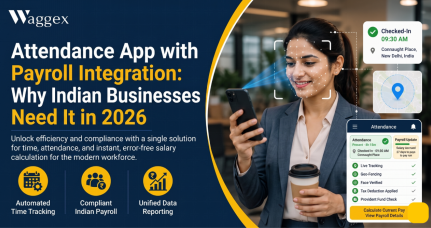
Attendance is the starting point of accurate payroll. If attendance records are wrong, salary calculation, leave deductions, overtime, and payslips may also become wrong. This is one of the biggest reasons Indian businesses are moving from manual attendance registers and basic spreadsheets to digital attendance systems.
A modern attendance app helps companies track employee check-in, working hours, late marks, leave, overtime, and attendance reports from one platform. When the attendance app is connected with payroll, HR teams do not need to transfer data manually at the end of every month. This reduces errors and saves time.
In 2026, Indian businesses are managing a more flexible workforce than before. Some employees work from the office, some work from client locations, some travel for sales, and some work in hybrid teams. A mobile attendance app with payroll integration can support these different working styles better than traditional manual records.
What Is an Attendance App with Payroll Integration?
An attendance app is a digital system that allows employees to mark attendance using a mobile phone, web login, selfie check-in, geo-location, or approved attendance method. It stores attendance records in real time and gives HR visibility into employee presence, absence, late arrival, and working hours.
Payroll integration means the attendance data is directly connected with salary processing. Instead of downloading attendance from one system and uploading it into another payroll file, HR can use the attendance records inside payroll calculation. This makes salary processing faster and more accurate.
For example, if an employee has two unpaid leaves, approved overtime, or late marks, the payroll system can use this data while calculating salary. This creates a smoother process for HR and a more transparent experience for employees.
Why Manual Attendance Creates Payroll Problems
Many small and mid-sized businesses still use paper registers, Excel sheets, WhatsApp messages, or supervisor updates to track attendance. These systems may look simple, but they create problems when teams grow or work from different locations.
- Employees may forget to mark attendance in registers
- Supervisors may send attendance updates late
- HR may enter attendance data incorrectly in Excel
- Leave and attendance records may not match
- Field employees may be difficult to verify manually
- Overtime and late marks may be calculated incorrectly
- Payroll processing may be delayed due to data checking
When attendance data is not accurate, payroll mistakes become common. Employees may receive wrong salary, HR may need to correct payslips, and managers may spend additional time verifying records. An attendance app helps businesses reduce these issues by creating digital, time-stamped records.
Attendance App vs Biometric Machine
Biometric machines have been used by many companies for office attendance. They work well when all employees come to one fixed location. However, modern businesses often need more flexibility. Field employees, remote teams, sales staff, real estate executives, service technicians, and multi-branch teams may not be able to use one biometric device.
| Comparison Point | Biometric Machine | Attendance App |
| Best use case | Single office or fixed workplace | Office, field, hybrid, and multi-location teams |
| Device requirement | Physical biometric machine required | Mobile phone or web access |
| Location tracking | Limited to device location | Geo-tagged attendance can verify location |
| Field employee tracking | Difficult | Easy with mobile check-in |
| Maintenance | Requires machine setup and maintenance | Software-based and easier to update |
| Payroll connection | May need export or manual sync | Can integrate directly with payroll |
| Scalability | More machines needed for more branches | Can support multiple teams and locations |
This does not mean biometric machines are always wrong. They can still be useful for office-only teams. But for companies with flexible workforces, mobile attendance apps offer better control and convenience.
Key Benefits of Attendance App with Payroll Integration
Accurate Salary Calculation
Payroll accuracy depends on attendance accuracy. When attendance data flows directly into payroll, HR can calculate working days, unpaid leave, leave deductions, overtime, and absences more reliably. This reduces disputes and builds employee trust.
Less Manual HR Work
Manual attendance checking takes time every month. HR teams often spend hours comparing attendance sheets, leave records, shift timings, and manager approvals. An integrated system reduces this repetitive work and allows HR to focus on review instead of data entry.
Better Field Employee Tracking
Many businesses have employees working outside the office. A geo-tagged attendance app can help verify where employees marked attendance. This is useful for sales teams, service staff, real estate executives, delivery teams, and site workers.
Faster Payroll Processing
When attendance and payroll are connected, payroll processing becomes faster. HR does not need to wait for manual reports from every manager. Approved attendance data can be used directly during salary calculation.
Improved Employee Transparency
Employees can view attendance, leave, and salary-related details if the system includes employee self-service. This reduces confusion and unnecessary HR queries.
Features to Look for in an Attendance App
Not every attendance app is suitable for every business. A company should choose a system based on employee type, work locations, payroll needs, and HR processes.
| Feature | Business Benefit | Best For |
| Mobile attendance | Employees can mark attendance from their phone | Office, hybrid, and field teams |
| Selfie check-in | Helps verify employee identity | Businesses reducing proxy attendance |
| Geo-tagged attendance | Captures location with attendance record | Field staff and multi-site teams |
| Leave management | Connects leave approvals with attendance | Growing businesses |
| Overtime tracking | Helps calculate extra working hours | Factories, retail, service teams |
| Payroll integration | Uses attendance data in salary calculation | All companies processing monthly payroll |
| Reports dashboard | Shows present, absent, late, and leave records | HR and business owners |
| Employee self-service | Employees can check attendance and payslips | Companies reducing HR queries |
Level Practical Use Cases
Office-Based Teams
Small offices can replace manual registers with a digital attendance app. HR can see daily attendance status and process payroll more easily.
Field Sales Teams
Sales employees can mark attendance from approved locations. Geo-tagged records help managers verify field movement and daily presence.
Real Estate Companies
Real estate teams often work from project sites, client meetings, and offices. A mobile attendance app helps track employees without depending on a single biometric machine.
Retail and Multi-Branch Businesses
Retail companies can manage attendance across multiple stores and connect that data with payroll for each branch.
Manufacturing and Shift-Based Workplaces
Shift-based businesses can use attendance records for overtime, late marks, absences, and payroll calculation.
How Attendance Apps Reduce Fake Attendance
Fake attendance can happen when employees mark attendance for others, manipulate manual registers, or provide incorrect updates. Digital systems can reduce this risk through verification features.
- Selfie-based check-in for identity verification
- Geo-tagged records for location verification
- Time-stamped attendance records
- Manager approval workflows
- Daily attendance reports
- Leave and overtime approval tracking
Businesses that want photo-based verification can also use selfie-based attendance software to reduce proxy attendance and improve the accuracy of daily attendance records.
Why Payroll Integration Is the Most Important Feature
Attendance data becomes most valuable when it is connected with payroll. If the attendance app only records check-in and check-out but does not connect with salary processing, HR may still need to export reports and enter data manually.
An integrated payroll management software system uses attendance, leave, overtime, and absence data for salary calculation. This reduces manual work and helps businesses complete payroll on time.
For example, a retail company with 80 employees across multiple locations can use digital attendance records to calculate working days quickly. A real estate company with field executives can verify location-based attendance and reduce payroll confusion. A service company can manage technicians who work at different client sites.
Role of HRMS Software in Attendance and Payroll
Attendance and payroll are part of a broader HR workflow. Businesses also need employee onboarding, leave approvals, salary structures, document management, reports, and employee self-service. When these processes work together, HR becomes more organized.
A connected HRMS Software can help companies manage attendance, payroll, employee records, and workforce operations from one system instead of using multiple disconnected tools.
Contextual Waggex Backlink Placement
Waggex provides a cloud-based Attendance App that helps businesses mark attendance, track leave, manage payroll, and reduce manual HR work from one connected platform.
For Indian companies that want attendance and payroll to work together, Waggex helps reduce manual HR work, improve salary accuracy, and create a more organized employee management process through its HRMS Software platform.
These links are placed naturally inside the article so the guest post remains informative while supporting SEO backlinks for Waggex.
Final Buying Checklist
| Question | Why It Matters | Recommended Choice |
| Does it support mobile attendance? | Employees should be able to mark attendance easily | Choose a simple app for daily use |
| Does it support geo-location? | Location verification helps field teams | Choose geo-tagged attendance if employees work outside the office |
| Does it connect with payroll? | Attendance affects salary calculation | Choose attendance app with payroll integration |
| Does it manage leave? | Leave records must match attendance and payroll | Choose a system with leave management |
| Does it reduce fake attendance? | Identity verification affects payroll accuracy | Choose selfie or verification-based features |
| Does it offer reports? | HR and owners need visibility | Choose dashboards and monthly reports |
Conclusion
An attendance app with payroll integration is becoming essential for Indian businesses because attendance directly affects salary accuracy. Manual registers, spreadsheets, and disconnected systems can create errors, delays, and employee disputes. A digital attendance app gives HR better visibility and makes payroll processing more reliable.
For companies with office teams, field staff, hybrid employees, retail stores, service workers, or multi-branch operations, mobile attendance can improve control and reduce manual work. When attendance, leave, overtime, and payroll are connected, businesses can process salaries faster and with fewer mistakes.
Waggex can be a strong option for businesses that want a simple cloud-based platform for attendance, payroll, HRMS, and employee management.
FAQs
What is an attendance app with payroll integration?
It is a digital attendance system that connects employee attendance records with payroll calculation so HR can process salaries more accurately.
Can an attendance app replace a biometric machine?
Yes, for many businesses with field, hybrid, or multi-location employees, an attendance app can be more flexible than a fixed biometric machine.
Why is geo-tagged attendance useful?
Geo-tagged attendance helps businesses verify where employees marked attendance, which is useful for field teams and remote workers.
How does attendance affect payroll?
Attendance affects working days, unpaid leave, overtime, late marks, and salary deductions. That is why accurate attendance data is important for payroll.
Which businesses should use an attendance app?
Offices, field sales teams, real estate companies, retail stores, factories, service businesses, and hybrid teams can benefit from an attendance app.