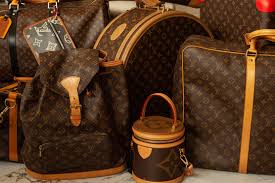
Louis Vuitton is the most counterfeited brand on the planet. The house has been producing luxury trunks, bags, and accessories since 1854, and the secondary market reflects that long history with a deep mix of genuine archive pieces and sophisticated fakes. Before you commit money to any piece, you need to know exactly what separates one from the other.
For collectors who want a vetted starting point, authentic vintage Louis Vuitton is best sourced through a curated, screened channel where the editorial filtering has already been done. Whether you source through a specialist platform or the open market, the authentication knowledge below applies at every step.
The Monogram Canvas – Pattern, Precision, and What Fakes Get Wrong
The Monogram canvas debuted in 1896, designed by Georges Vuitton to honour his late father. The interlocking LV initials, quatrefoil flowers, and pointed stars have remained virtually unchanged since that year. On an authentic piece the pattern aligns perfectly at every seam. It does not get cut off arbitrarily at a pocket edge or panel border.
The canvas colour is a warm golden-brown that deepens naturally with age and use. Counterfeits frequently print too dark, too orange, or with a pattern that looks slightly inflated or blurry. The LV monogram on a genuine piece is crisp and symmetrical – even small deviations signal a problem, and they are not hard to spot once your eye is trained.
The canvas itself should feel firm and slightly stiff on older pieces. As leather-trimmed styles age, the canvas may soften slightly at flex points near handles and straps, but it should never feel floppy, papery, or plastic-like. The texture has a distinctive woven quality that cheap counterfeits rarely replicate convincingly.
Hardware and Stitching as Dating Tools
Vintage Louis Vuitton hardware tells a clear story about when a piece was made. Pieces produced before the 1990s typically carry brass hardware with a warm, aged tone. Zippers on bags made before the mid-1980s were often sourced from Eclair or Opti rather than YKK, which became more common in later production runs. Checking the zipper branding is a reliable dating method that most buyers overlook.
Stitching is equally informative. Louis Vuitton uses a specific honey-gold thread on Monogram canvas pieces, applied in tight, even passes. Any loose threads, skipped stitches, or variation in thread colour are immediate red flags. The thread should look intentional and precise from the first stitch to the last – not fraying, uneven, or noticeably thick in some areas and thin in others.
The S-lock hardware used on the Keepall and similar styles is a particularly useful authentication point. On genuine pieces the lock body is solid and heavy, the closure has a satisfying resistance, and it snaps shut cleanly. Counterfeits often produce a lock that rattles, feels hollow, or fails to close evenly.
The Date Code System – What It Tells You and What It Doesn’t
Louis Vuitton began stamping date codes inside bags in the early 1980s. Before that, pieces carried no date code at all – so a vintage bag without one is not automatically a fake. Understanding the system matters most for pieces made after 1982.
The format changed over time. From 1982 to 1989, codes consisted of three or four numbers indicating the month and year of manufacture. From 1990 onward, the format added two letters indicating the country of production. A code reading “AR0062” indicates a piece made in France in the sixth week of 2002. Louis Vuitton ran this system through 2021, when production switched to RFID chips embedded in a small leather tab.
Additionally, a correct date code does not confirm authenticity on its own. Counterfeiters know every format iteration. A piece with a plausible code but wrong canvas feel, misaligned pattern, or incorrect stitching is still a fake. The code is one data point, not the final verdict.
Reading the Vachetta Leather
Most Monogram canvas bags carry natural Vachetta leather on the trim, handles, and base. This untreated cowhide starts pale and creamy, then darkens through oxidation and handling to a rich honey-brown over years of use. Any piece genuinely described as vintage should show a degree of natural patina.
Be cautious of two extremes. A bag sold as a 1980s or 1990s piece with perfectly pale, untouched Vachetta has likely had its leather replaced, or the seller is misrepresenting its age. On the other end, very dark or blackened leather with visible surface cracks signals years of neglect and potential structural damage. Medium to deep honey tones, consistent across all leather areas, indicate a well-maintained piece that has aged naturally.
The Damier Canvas, Epi Leather, and Vernis
The Monogram gets the most attention, but the Damier canvas has a strong and growing collector following. First introduced in 1888 and relaunched in 1996, pre-relaunch Damier pieces are genuinely rare on the secondary market. The checkerboard pattern should be perfectly even, the colouring a rich chocolate and warm gold, and the canvas firm rather than pliable.
Epi leather, introduced in 1985, represents some of the most wearable archive pieces available. The distinctive textured surface was produced in a wide range of colours during the late 1980s and early 1990s – Toledo blue, red, black, yellow, and green among others – many of which the current house no longer produces. These pieces offer archival rarity alongside everyday functionality.
The Vernis line, introduced in 1998, is becoming increasingly collectible. Early Vernis in the original pale rose, bronze, and lavender colourways has developed a strong following among collectors of late-1990s and early-2000s pieces. The lacquered surface should be even and free of deep crazing – surface yellowing is common with age but should be noted by any seller and priced accordingly.
What the Interior Reveals
Even well-executed counterfeits tend to fail on the interior. Louis Vuitton uses a specific microfibre or canvas lining depending on the era and bag style. The texture, weight, and even the scent of a genuine interior are difficult to replicate. Authentic pieces carry a clean, faintly leathery smell – not a chemical or sharp synthetic odour.
The heat stamp – the gold lettering pressed into the interior leather tab or exterior surface – should be clean and even in depth across every letter. “Louis Vuitton Paris Made in France” should be fully legible without magnification. Uneven letter depth, inconsistent font weight, or any misalignment are immediate tells. Examine this detail under good light before every purchase.
The Silhouettes That Hold Their Value
The resale market for authenticated Louis Vuitton has strengthened steadily over the past decade. Certain silhouettes attract sustained demand regardless of current fashion trends. The Speedy 25 and 30, the Alma, the Keepall, the Noe, and the Papillon are the core of the market and rarely sit unsold for long.
The Speedy in particular has a cross-generational appeal that is difficult to overstate. First produced as a custom piece for Audrey Hepburn in 1959 and introduced to the broader public in 1965, the bag has been continuously made since and shows no meaningful decline in secondary market demand. Vintage examples predating the 1990s carry the most collector interest, particularly in the smaller 25 and 30 sizes.
Limited Editions and Artist Collaborations
Limited editions and artist collaborations from the early 2000s have appreciated sharply and crossed from fashion into cultural artefact status. The Stephen Sprouse Graffiti collection from 2001 was the first major artist collaboration of the modern Louis Vuitton era and remains among the most collectible. The Takashi Murakami Multicolore from 2003 produced dozens of shapes and colourways, all of which carry strong premiums in genuine condition.
The Cerises collection from 2005, the Richard Prince collaboration from 2008, and the Yayoi Kusama pieces from 2012 have all followed a similar trajectory. These pieces are well documented in the collector community, which means authentication resources are widely available – and also means counterfeiters have invested in faking them at a high level. Provenance documentation matters even more for limited editions than for standard production.
The collector market is wide, the demand is real, and authentication stakes are high at every price point. For buyers at any stage of building their archive, Foundry Vintage is a focused, editorially curated resource sourced from vetted resellers – a practical starting point for collectors who want quality assurance built into the discovery process rather than bolted on at the end.