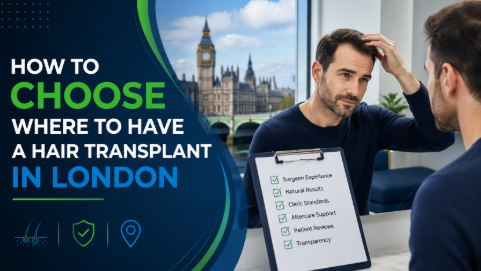
The clinic you pick matters for far longer than the day of surgery. The operation itself is one long appointment. The result takes the better part of a year to appear, and most of what can go wrong, or simply needs checking, shows up weeks or months after you walk back out of the door. The useful question when comparing clinics is therefore not only who performs the procedure, but who you can sit in front of in month three.
That reordering also changes what a price comparison means, because two quotes only compare properly when they cover the same amount of follow-up.
Why the follow-up window drives the decision
Transplanted hair does not carry on growing from the day it is placed. In most patients the moved hairs shed within the first weeks, the scalp then looks much as it did before surgery, and new growth starts coming through a few months later. Density usually keeps improving for around a year, and slower areas such as the crown can take longer still. Timing varies from person to person, which is precisely why scheduled reviews are worth having rather than optional extras.
The same window covers everything a clinic should be watching. How the donor area heals. Crusting and the first careful washes. Folliculitis or ingrown hairs as growth begins. Numbness that settles slowly. An honest look at six and twelve months at whether the coverage you agreed on has actually arrived. None of these are emergencies, and none of them are unusual. They are the ordinary business of a surgical result maturing, and they are far easier to deal with in a consulting room than through a messaging app.
From the first consultation to the final review
Clinics differ in the detail, but a course of treatment in London normally runs through the same stages.
- Consultation and scalp examination. A clinician assesses your pattern of loss, the density and laxity of the donor area, your medical history and any medication, and whether surgery is the right step at this point at all.
- A written plan. Technique, an estimated graft number, the areas to be covered and the hairline design should be agreed and photographed before money changes hands, with the risks and the alternatives discussed by the person who will operate.
- Preparation. Any tests the clinic asks for, clear instructions on what to stop and what to continue, a day cleared in the diary and a sensible plan for getting home afterwards.
- The procedure. Hair transplants are carried out under local anaesthesia, so you are awake throughout, and the appointment usually fills most of a day with breaks.
- The first two weeks. The clinic should teach or perform the first wash and give specific instructions on sleeping position, sun, sweat, headwear and medication.
- Reviews. Follow-up appointments spread across the months while growth comes through, finishing with an assessment of the mature result.
Two of those stages carry most of the weight. The consultation decides whether the plan is realistic for the donor hair you actually have, and the review schedule decides how quickly anything unexpected gets caught. Vagueness about either one tells you more than the brochure does.
Staying in the UK compared with travelling abroad
Anyone weighing up a hair transplant in London UK against a package abroad is comparing two aftercare arrangements as much as two operating rooms. Travelling for treatment is a legitimate choice and plenty of patients are happy with the outcome. What differs is where the follow-up happens, who answers when something looks wrong, and what a return visit would cost in time and money.
| Point to settle | Treatment in London | Treatment abroad |
|---|---|---|
| First assessment | Face to face before any deposit | Often remote and photograph based at first, with the examination close to the surgery date |
| Routine follow-up | A short journey back to the same team | Usually remote, or another flight |
| If a complication appears | Seen by the clinic that operated | Ask for a named doctor and for who can see you here in the meantime |
| Revision or second session | Arranged with the same surgeon | Depends on the contract and on travelling again |
| Time commitment | One clinic day, then recovery at home | Several days away plus recovery, with sun and swimming restricted |
| Cost drivers | Grafts, technique and what the package includes | The same, plus flights, hotel and any return trip |
| Your records | Held by a clinic you can telephone | Ask for operative notes and graft counts in writing before you fly home |
The Royal College of Surgeons gives patients considering surgery overseas a checklist that works just as well for a clinic ten minutes down the road: get the aftercare package in writing, including how long the surgeon will support you, secure a named doctor rather than a helpline for complications, and speak with the surgeon who will actually carry out the procedure before you consent. It also points out that ordinary travel insurance tends to exclude complications of elective surgery, which makes the clinic’s own cover a fair question to ask.
NHS guidance sets the boundary on the other side. Routine aftercare, revision or cosmetic correction of private surgery you chose to have abroad is not something the health service undertakes to provide, though a serious complication is assessed and treated on clinical need like any other urgent problem. Planning for that gap in advance is more comfortable than discovering it during the third week of recovery.
Several London clinics are built around exactly this trade-off. MediWell Hair Clinic, based at 1C Lansdowne Rd in north London, describes its model as Turkish hair transplant expertise delivered in London so that patients do not need to fly to Turkey for surgery, and lists Sapphire FUE, DHI, hybrid, eyebrow, beard and moustache and Afro hair transplant procedures. The clinic states over a decade of experience and thousands of procedures, with a free consultation before any commitment. Statements of that kind, from any clinic, are worth testing in the consultation room.
The checks you can make yourself
Most of these take minutes, and several of them rely on public records rather than on what the clinic tells you.
- Provider registration. In England, a clinic carrying out hair transplant surgery has to be registered with the health and social care regulator for the regulated activity of surgical procedures, and its registration details and inspection reports are published online. Scotland and Wales have their own inspectorates.
- The operating doctor. The UK medical regulator keeps a public register you can search by name to confirm the doctor and check that they hold a licence to practise.
- Who does what on the day. Ask which parts of the procedure the doctor performs personally, which are carried out by technicians and how they are supervised. Practice varies between clinics and this is rarely volunteered.
- Photographs that match you. Ask for before and after cases with a similar hair type, colour, loss pattern and stage, shot in comparable lighting, rather than only the strongest results in the gallery.
- The aftercare package in writing. What is included, for how long, and what a follow-up appointment costs once that period runs out.
- The complication route. A named clinician, a way to reach the clinic outside working hours, and a clear answer on how quickly you would be seen.
- The second session question. How a further session or a revision would be assessed, timed and charged if your clinician recommends one.
- Time to think. A deposit taken at the end of a first consultation is a decision made under pressure, and a clinic that expects you to go away and consider it is behaving normally.
When surgery is not the right next step
A consultation that ends without a booking is sometimes the most valuable appointment in the process. A transplant moves hair rather than creating new follicles, so everything rests on what the donor area can spare relative to the area you want covered.
A clinician may advise waiting, or a different approach entirely, when loss is still progressing quickly and the eventual pattern is not yet clear, which is common in younger patients. The same applies when the donor area is too limited for the coverage being requested, when hair loss is patchy or undiagnosed or comes with scalp inflammation, scarring or other symptoms that need investigating first, and when the expectation is the density of a teenage head of hair, which redistribution cannot produce. Medical treatment for ongoing loss is sometimes recommended alongside or instead of surgery, and that judgement belongs to the clinician who has examined you.
How to read a quote
Cost follows the number of grafts, the technique, how long the session runs and whether more than one session is planned. Before comparing two figures, find out what each one actually contains.
- Whether the consultation, medication, the first wash and the follow-up appointments sit inside the price.
- Whether the graft number is an estimate or a commitment, and what happens if fewer or more are placed on the day.
- Whether a second session, should one be needed, is quoted separately.
- For treatment abroad, flights, accommodation, transfers and the cost of any return trip for a review or a revision.
Ask for the final figure in writing after the consultation, and read the clinic’s own price page for what its packages cover, since an estimate only becomes meaningful once it is attached to your graft requirement rather than to an average patient.
Questions patients ask next
How much time off should I plan for?
Most people set aside the first week, less because they feel unwell than because redness, small crusts and some swelling are visible for several days. Exercise, swimming, saunas and anything that presses on the grafts stay restricted for longer, and your clinic sets the exact timings for your case.
Will one session be enough?
It depends on the size of the area, what the donor can spare and whether loss continues afterwards. The thing to settle before booking is not a number but the process: how a further session would be assessed, when it could take place and what it would cost.
I had a transplant abroad and now need advice. What are my options?
Contact the operating clinic first if you can still reach it, since it holds your operative notes and graft counts, and ask for those records to be sent to you. A UK clinic can then examine the scalp and advise on what is happening. Anything urgent, such as spreading infection or a fever, needs same day medical attention rather than a message thread. Take your photographs, discharge notes and medication list to the appointment.