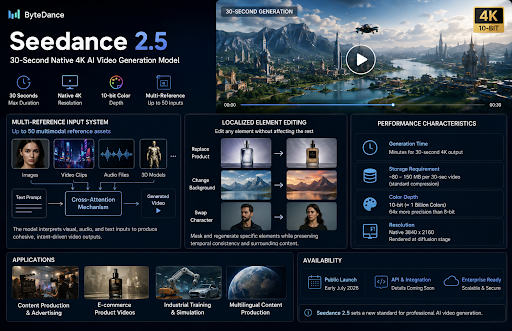
The AI video generation market reached an inflection point in June 2026 with ByteDance’s announcement of Seedance 2.5 at the Volcano Engine FORCE conference. The model introduces a specification profile that addresses the four primary technical constraints that have limited professional adoption of AI video generation: duration, resolution authenticity, reference precision, and editing granularity.
Architecture and Specifications
Seedance 2.5 generates up to 30 seconds of temporally coherent video in a single generation pass at native 4K resolution with 10-bit colour depth. The generation architecture processes the entire 30-second output as a unified temporal sequence rather than assembling shorter segments, which eliminates the temporal consistency issues that characterise multi-clip approaches.
The native 4K rendering occurs at the diffusion stage, meaning the model computes visual information at 3840 by 2160 resolution throughout the generation process. This contrasts with the upscaling approach used by most competing models, which generate at 720p or 1080p and apply super-resolution algorithms to increase pixel count post-generation. The distinction is measurable in high-frequency detail preservation: textile patterns, hair strand separation, material surface textures, and fine architectural details are all better preserved under native rendering.
The 10-bit colour depth provides approximately one billion colour values compared to 16.7 million at 8-bit, increasing colour precision by a factor of 64. This additional precision reduces gradient banding artefacts and provides greater headroom for post-production colour grading operations.
Multi-Reference Input System
The model accepts up to 50 multimodal reference assets per generation request. Supported input types include raster images in standard formats, video clips, audio files, and 3D model files. The reference system implements a cross-attention mechanism that allows the model to attend to visual information from reference assets alongside the text prompt during generation.
This architecture enables asset-driven creative direction rather than text-only prompting. Users can provide character reference sheets, brand asset libraries, environmental concept art, material samples, and audio direction as direct model inputs. The model interprets spatial relationships, stylistic qualities, and compositional preferences from the reference set, producing output that reflects both explicit text instructions and implicit visual direction from reference materials.
During the FORCE conference demonstration, the system processed over ten simultaneous character references with autonomous casting and scene choreography — indicating that the cross-attention mechanism can handle complex multi-entity reference sets without manual spatial specification.
Localized Element Editing
The model supports element-level editing through a masking and regeneration approach that preserves non-targeted regions of the generated video while replacing specified elements. Products, backgrounds, and characters can be swapped independently while maintaining temporal consistency in surrounding visual elements.
This capability has significant implications for production workflows that require content variants. Advertising campaigns frequently need dozens of creative versions: product SKU variants, seasonal adaptations, regional modifications, and A/B test versions. Under full-regeneration workflows, each variant carries nearly the full computational and quality-assurance cost of the original. Under localized editing, variant cost reduces to the computational overhead of the targeted replacement plus quality verification of the modified element.
Performance Characteristics
Detailed performance benchmarks have not been published. Based on conference demonstrations, generation latency for 30-second 4K output appears to be measured in minutes rather than seconds. Storage requirements for 30 seconds of 4K 10-bit video at standard compression ratios range from approximately 80 to 150 MB per generation depending on content complexity.
Applications and Use Cases
The model’s specification profile supports applications across several domains. Content production and advertising benefit from 30-second generation at professional quality with efficient variant production. E-commerce product video generation leverages the native 4K detail preservation for product texture and material communication. Industrial training data synthesis uses the extended generation length and physical consistency for autonomous driving, robotics, and simulation applications. Multilingual content production uses the model’s ability to generate video documentation across languages from a single input set.
Availability and Integration
Seedance 2.5 is in final-stage internal testing with public availability expected in early July 2026. API specifications, pricing, rate limits, and enterprise support details have not been announced. Developers planning integrations should monitor the July launch for API documentation and evaluate their infrastructure requirements for native 4K 10-bit content handling.