

Selling property through traditional channels can be a slow, unpredictable process. Listings may sit on the market for months, price negotiations drag on, and the lack of competitive pressure often results in final sale prices that fall below expectations. For sellers, brokers, and asset managers dealing with time-sensitive portfolios or distressed properties, these delays translate directly into lost revenue and increased holding costs.
What Is Real Estate Auction Software?
Real estate auction software is a specialized platform designed to facilitate the sale of residential, commercial, and land properties through a structured, time-bound bidding process. Unlike general auction tools, these solutions account for the unique requirements of real estate transactions: bidder pre-qualification, earnest money deposits, property due diligence documentation, and legally binding purchase agreements.
In other words, the platform replaces the fragmented combination of MLS listings, phone negotiations, and paper contracts with a single digital environment where every step of the sale is managed, tracked, and documented. What is also important here is that the software serves both sides of the transaction, giving sellers control over auction parameters while providing buyers with the transparency and access they need to bid confidently.
When Does It Make Sense to Use Auction Software for Property Sales?
Auction-based sales are not appropriate for every property or market condition, but there are well-defined scenarios where this approach delivers clear advantages over traditional listing methods. Understanding these use cases can help sellers and brokers determine when an auction strategy is the right fit.
The most common scenarios include:
- Properties that have been on the market for an extended period without receiving acceptable offers.
- Distressed or foreclosure assets where the lender or servicer needs to liquidate within a defined timeframe.
- Estate sales or portfolio dispositions involving multiple properties that must be sold simultaneously.
- Luxury or unique properties where traditional comparable pricing models are unreliable and competitive bidding may reveal true market value.
- Commercial assets such as office buildings, retail spaces, or land parcels where buyer pools are specialized and time-to-close matters.
- Government or institutional surplus property sales that require a transparent, auditable disposition process.
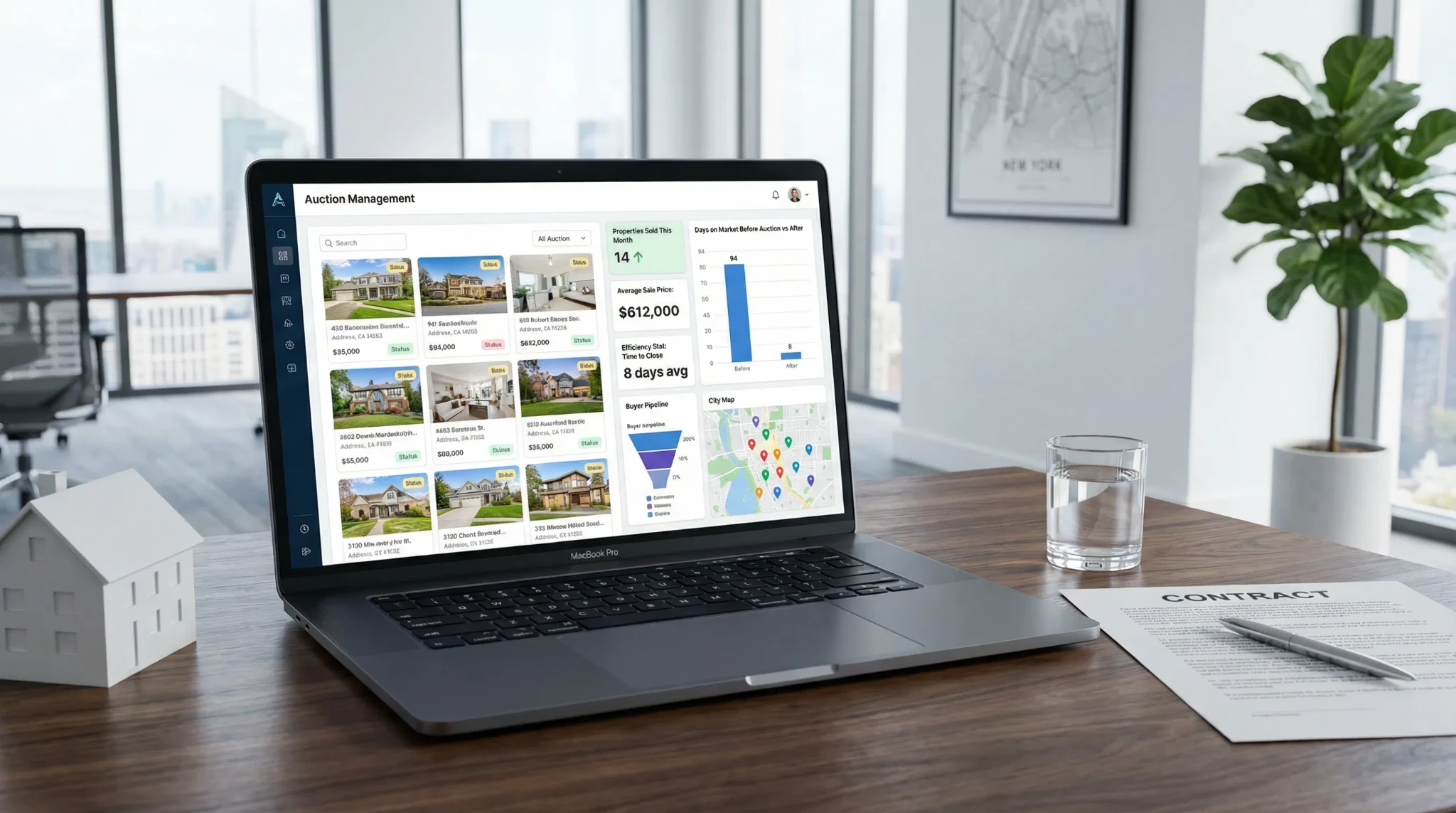
From a financial perspective, properties sold at auction often close significantly faster than those marketed through traditional channels. This reduction in days on market directly lowers carrying costs such as taxes, insurance, maintenance, and opportunity cost on tied-up capital.
Key Features That Streamline the Sales Process
The efficiency gains from auction software come from specific functionality designed to address the bottlenecks inherent in traditional property sales. The following features represent the capabilities that have the most direct impact on speed, transparency, and final sale outcomes.
Automated Bidder Pre-Qualification
One of the biggest time sinks in property sales is vetting potential buyers. Automated pre-qualification allows the platform to collect proof of funds, identity verification, and signed terms of sale before a bidder gains access to the auction. This ensures that only serious, financially capable participants enter the bidding process.
Thanks to this mechanism, sellers avoid wasted time on unqualified inquiries, and the auction itself moves forward with a pool of vetted bidders. This positively affects both the pace of the event and the credibility of the final sale.
Centralized Due Diligence Rooms
Buyers need access to property documentation before placing bids: inspection reports, title searches, surveys, environmental assessments, and financial disclosures. A virtual due diligence room centralizes all of these documents in a secure, organized repository accessible to approved bidders at any time.
Apart from this, the platform can track which documents each bidder has viewed, providing the seller with insight into buyer engagement levels and seriousness. This approach drastically reduces the back-and-forth of document requests that typically slows down conventional transactions.
Real-Time Competitive Bidding
The core advantage of an auction format is competitive pressure. When multiple qualified buyers bid against each other in real time, the final price is determined by actual market demand rather than a single negotiation between one buyer and one seller. More engaged users create more competition, and more competition tends to drive prices closer to (or above) fair market value.
The platform should support multiple bidding formats to accommodate different property types and seller preferences. The most widely used options are absolute auctions (no reserve price), reserve auctions (minimum price must be met), and sealed-bid formats where offers are submitted privately and revealed simultaneously.
Integrated Contract and Closing Workflows
The period between winning bid and closing is where a lot of traditional deals fall apart. Integrated contract workflows allow the platform to generate purchase agreements automatically based on pre-defined auction terms, collect electronic signatures, and initiate earnest money transfers immediately after the auction concludes.
This eliminates the delays associated with drafting contracts manually, mailing documents, and coordinating between multiple parties. The faster a binding agreement is executed, the lower the risk of buyer withdrawal or deal collapse.
Marketing and Exposure Automation
Attracting a sufficient pool of qualified bidders is essential for competitive outcomes. Modern platforms include built-in marketing tools that automate property promotion across multiple channels, including email campaigns, social media distribution, and syndication to third-party real estate portals.
These mechanics boost bidder acquisition without requiring separate marketing infrastructure. The platform can also track which channels drive the highest registration and bidding rates, enabling sellers to refine their promotional strategy for future auctions.
How to Choose the Right Real Estate Auction Platform
Selecting a platform requires evaluating both technical capabilities and industry-specific functionality. We recommend a structured assessment that goes beyond feature lists and examines how well the platform handles the unique demands of real estate transactions.
What reliable real estate auction software should have:
- Configurable auction formats supporting absolute, reserve, and sealed-bid models within a single platform.
- Bidder pre-qualification workflows with document upload, identity verification, and proof-of-funds validation.
- Secure due diligence rooms with granular access controls and document view tracking.
- Automated contract generation with e-signature integration and earnest money collection.
- Multi-channel marketing tools with performance tracking across email, social, and listing syndication.
- Compliance with state and federal auction regulations including licensing requirements that may vary by jurisdiction.
It will be helpful to request a demo using a realistic property scenario rather than a generic test environment. Pay attention to how the platform handles bidder onboarding, document management, and the transition from winning bid to executed contract. If any of these steps require manual intervention outside the platform, that may indicate a gap in workflow automation.
Final Word
Real estate auction software addresses the core inefficiencies of traditional property sales by compressing timelines, automating administrative processes, and introducing competitive bidding dynamics that drive prices toward true market value. The key features outlined above, from bidder pre-qualification and centralized due diligence to integrated contract workflows and marketing automation, form an interconnected system that removes friction at every stage of the sales cycle.
Ultimately, the right platform should do more than digitize an existing process. It should fundamentally improve the speed, transparency, and financial outcome of every property transaction. Organizations that evaluate platforms against the criteria discussed in this article will be well positioned to select a solution that delivers measurable results from the very first auction.