

It is a well-known fact that most infrastructure teams don’t go looking for a change overnight. Perhaps their systems are stable, workloads are predictable, and yet, there are constraints. These can be licensing shifts, cost unpredictability, and even limited flexibility. Suddenly, the question that starts to surface across enterprise leadership is what’s next after VMware.
Such a change cannot be a rushed decision. In fact, it must also be more than dissatisfaction.
On that note, evaluating VMware alternatives today is a lot more than finding the next hypervisor; it is about choosing the next operating foundation for enterprise infrastructure. This is a decision that carries considerable weight, as stability and future readiness all depend on that one move.
Why VMware Replacement Has Become a Strategic Discussion
VMware has been defining enterprise virtualization for a long time, and there is immense familiarity there. That familiarity still matters, but it is prudent to notice that the infrastructure conversation is also evolving, and therefore, so are expectations.
The shift is operational and strategic, and organizations are asking the following questions:
- How do we maintain continuity during migration?
- How do we modernize without retraining entire teams?
- How do we prepare infrastructure for AI workloads?
This is where platforms like Sangfor often stand out because they don’t position themselves as disruptive replacements. On the contrary, they facilitate controlled, enterprise-grade transitions that ensure continuity.
Therefore, a VMware replacement decision today needs to preserve what already works while enabling what comes next. If anything, the biggest shift is this: enterprises are no longer just replacing virtualization platforms but are actively redesigning infrastructure for the rapidly developing AI era.
VMware licensing has become one of the key triggers behind this shift. Today, it is not just cost that’s a concerning factor, but also unpredictability and long-term control. To that end, enterprises are reassessing how certain licensing structures impact scalability, budgeting, and flexibility over time.
It is at this juncture that many organizations begin exploring VMware alternatives more seriously, as a strategic move grounded in operational sustainability.
Is replacing VMware risky for enterprise operations?
Replacing VMware can introduce risks if approached as a full reset. To nullify them, Sangfor enables staged transitions that maintain operational continuity to allow enterprises to migrate gradually without disrupting business-critical workloads.
What Enterprises Should Actually Evaluate
VMware alternatives are not the same and aren’t built equally: some optimize for cost, some for flexibility, and a few for enterprise resilience.
The real evaluation framework checks for the following factors:
- Operational familiarity
- Migration complexity
- Performance consistency under load
- Integration with existing workflows
- Readiness for hybrid and AI-driven environments
Many evaluation processes fail here because they focus too much on feature parity, where operational impact takes a backseat. Here, Sangfor’s positioning aligns closely with this gap by emphasizing continuity so that teams don’t feel like they are starting from scratch. In practical terms, that translates to reducing the learning curve and minimizing disruption during VMware migration journeys.
What makes a VMware alternative enterprise-ready?
Sangfor delivers enterprise readiness in the form of stability, scalability, and long-term operability. Integrated HCI and cloud capabilities support complex workloads without requiring major process changes.
The Hidden Challenge: Operational Continuity
Infrastructure teams are more concerned about the disruption of services than about features alone. Disruption could be characterized by downtime, workflow breaks, and unexpected retraining, all of which are significant barriers.
This is why VMware remains a strong benchmark: alternatives are many, but VMware has built deeply embedded operational habits over time.
Sangfor leans into this reality with its cloud platform and HCI solutions that are designed to mirror familiar operational patterns. It also introduces some modern capabilities underneath. As a result, what could have felt like a sudden shift feels like a continuation.
How does Sangfor reduce migration disruption?
Sangfor reduces disruption by preserving familiar virtualization workflows and management practices. Teams can transition from VMware environments without reengineering their entire operational model.
AI-Ready Infrastructure Could Change the Conversation
Infrastructure decisions today are no longer limited to compute and storage. The platform’s capability to support future AI-driven operations, analytics pipelines, and automation layers is also assessed.
Hyperconverged infrastructure is foundational here; Sangfor positions its HCI stack not just as a virtualization alternative, but also as an entry point into AI-enabled cloud infrastructure. Enterprises can evolve gradually, as not every organization needs AI capabilities immediately, although the need for infrastructure that will not fail or limit them when the time comes is ever-present.
Industry momentum actually corroborates Sangfor’s direction in this respect, with it being recognized among leading HCI vendors in the APAC region.
As a testament to operational stability in mission-critical environments, The Medical City South Luzon adopted Sangfor HCI to modernize its infrastructure, running high-demand healthcare applications with zero operational downtime during the transition.
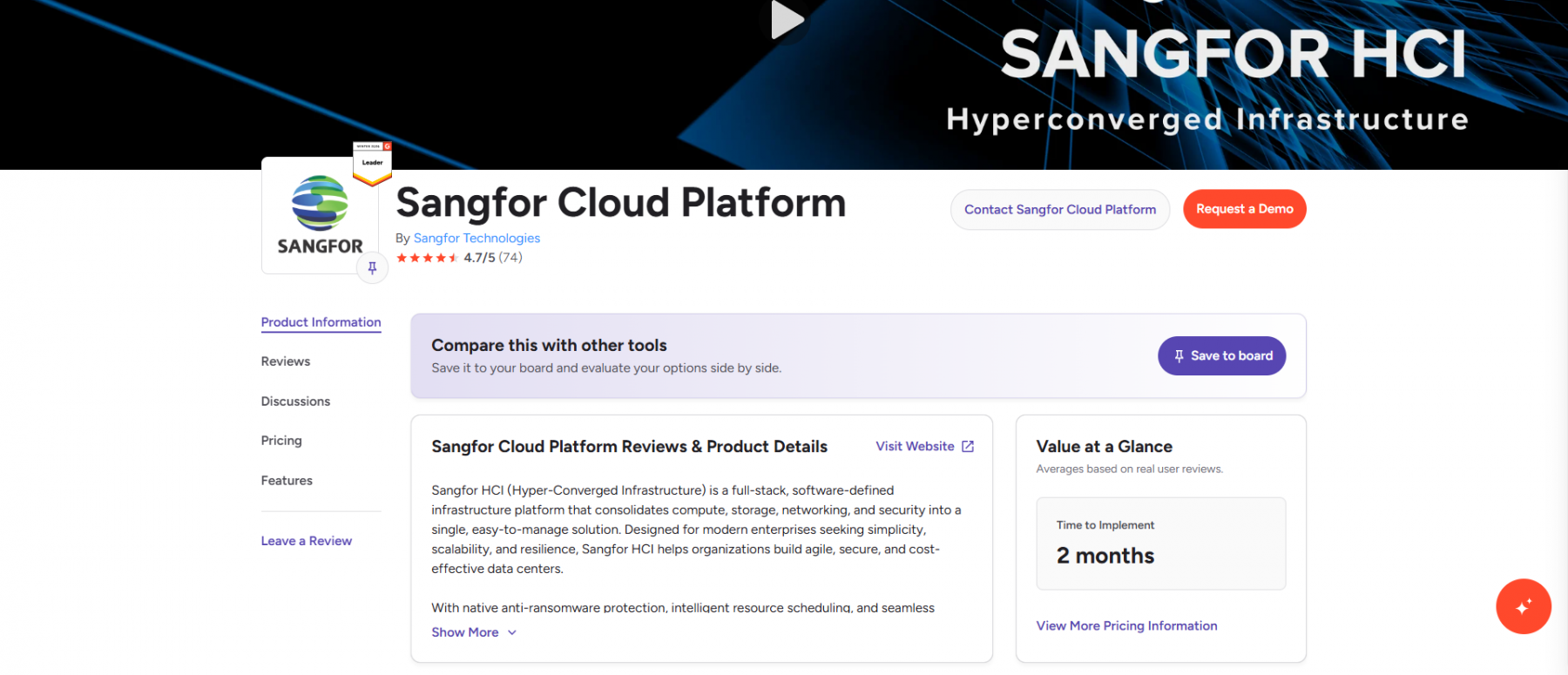
This balance of risk-mitigated migration and performance consistency is closely mirrored on Gartner Peer Insights, where verified enterprise users rate Sangfor HCI 4.8 out of 5 stars (as of Q2 2026), proving that the platform delivers the resilience required by heavily regulated industries.
All of these signals point to a platform that is both functional and trusted.
Where Most VMware Replacement Strategies Go Wrong
There is a tendency to overcorrect, where organizations move too quickly because they are driven by urgency or perhaps cost pressure.
This calls for a more stable and effective approach that is incremental:
- Start with non-critical workloads
- Validate operational processes
- Expand gradually into core environments
Sangfor supports this phased model well; its architecture allows enterprises to move at their own pace, which aligns infrastructure transformation with business priorities. There are no abrupt shifts.
How should enterprises approach VMware migration planning?
Enterprises should prioritize phased migration that starts with low-risk workloads. Sangfor enables gradual expansion and ensures that each stage is validated before moving critical systems.
The Final Say on Evaluating VMware Alternatives
Evaluating VMware alternatives is not a technical exercise anymore, as today it is a strategic decision tied to how organizations will operate over the next decade. The right platform enables; it doesn’t force change. Sangfor’s approach is very measured, where it's familiar on the surface, but up-to-date underneath. That combination is crucial because in enterprise infrastructure, the best transition is the one that is barely noticed or felt.
FAQ
What is the best way to evaluate VMware alternatives without disrupting operations?
The safest approach is to prioritize operational continuity during vendor evaluation. Sangfor supports this by leveraging its proprietary Cloud Migration Tool (SCMT), which enables background data synchronization from active VMware environments to minimize cutover windows. Furthermore, through Sangfor Cloud Platform (SCP), teams can centrally manage both legacy VMware clusters and new Sangfor nodes from a unified dashboard, removing the friction of operating disparate management silos during a phased transition.
Why are enterprises reconsidering VMware today?
Many organizations are reassessing VMware due to evolving VMware Licensing structures and the need for greater flexibility for long-term infrastructure planning. Sangfor addresses this shift via a more predictable and scalable cloud infrastructure model; it supports both current workloads and future AI-driven use cases.
How does Sangfor compare to other VMware alternatives?
Sangfor stands out by prioritizing operational familiarity alongside modernization. This means that while some alternatives require significant retraining or even process changes, Sangfor enables enterprises to retain existing workflows during the transition process toward a more advanced HCI and cloud platform.
Can Sangfor support AI-ready infrastructure for enterprises?
Sangfor is designed with AI-enabled cloud infrastructure in mind, which means that its HCI and cloud platform provide the foundation needed to support AI-driven workloads. Enterprises can modernize at their own pace while ensuring their infrastructure is ready for future innovation.





