

It’s a well-known fact that students stop paying attention when learning feels passive, and this issue shows up in classrooms of every age group. But do you know how many?
In the NAIS Report on the 2022 Middle Grades Survey of Student Engagement, 76% of students said they were sometimes or often bored in class.
Even if we put aside how high this number is, it also points to a larger problem: many students want to succeed, but traditional teaching methods don’t always keep them involved.
That’s why many schools and learning companies, such as Savvas, have started working more on interactive learning experiences that encourage participation, not just passive listening.
If you’re interested in knowing more about these solutions, keep reading.
Project-Based Learning
One sure way to make students become more invested in lessons is to have them understand why the material matters.
Instead of just memorizing information, project-based learning moves the focus to applying it in practical situations. Students then don’t have to listen to long explanations and complete worksheets, but work on projects that require research, collaboration, and problem-solving.
Rather than leading every step, the teacher guides students through the process, answers questions, and helps them improve their ideas. It’s all about making students more responsible but without leaving them unsupported.
Here are some examples:
- A science class learning about environmental issues could create water conservation plans for their community
- A history class could build presentations comparing past events with current social issues
- A math class could design a monthly budget plan using real housing, grocery, and transportation costs to understand how percentages, taxes, and financial planning work in everyday life
The Flipped Classroom
In many, still traditional, classrooms, students spend most of the lessons listening and only begin practicing the material once they get home (some have to be motivated to do it at home).
The flipped classroom changes that structure by literally flipping it. Students review lesson content before class through short videos, reading assignments, or digital materials.
Suddenly, the classroom stops being dull and becomes a place for discussion, practice, and activities.
More importantly, students are in control of their learning. Is someone needing extra time with a topic? They can rewatch or review the material as many times as they need to. Is someone learning more quickly? They can move to advanced activities.
Teachers can interact with students individually and answer any questions, guide group work, and spot areas where they need the most support.
The Jigsaw Technique
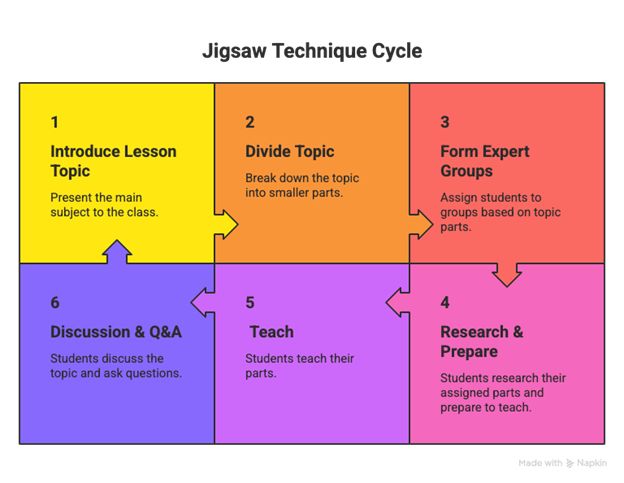
The jigsaw technique is another solution that makes students active participants by asking them to teach part of a lesson to their classmates.
Instead of working with the same material at the same time, every student becomes responsible for learning one section of a topic and explaining it to everyone else later.
Above anything else, this approach encourages accountability because each student plays a role in the discussion. If one person doesn’t prepare, the entire group misses part of the lesson. For this exact reason, with this structure, students usually stay more focused and involved.
And since they have to organize information, explain ideas to everyone, and respond to questions from their peers, their communication skills improve. This is very important, especially for those who are quieter.
The Ripple Method
While on the topic of quieter students, some need more time to think before speaking in class.
The tipple method works wonders for them, as it builds participation in stages instead of putting students on the spot immediately.
Generally, it works like this:
- Each student thinks about a question on their own
- They talk about their ideas in small groups
- They share responses with the rest of the class
Even the shyest students can feel more confident as this method gives them time to organize their thoughts before speaking in front of everyone else. Group conversations also help them expand their ideas after hearing different perspectives from classmates.
It works especially well in classrooms with only a small number of students.
Every teacher knows what it’s like to rely on the same volunteers every time. Well, the ripple method creates more opportunities for everyone to take part. Even short discussions can elevate attention levels because students stay active rather than passively listening.
Educational Games and Gamified Learning
Maria Montessori once said, "Play is the work of the child." While she was talking about younger children, the same applies to those in classrooms — play is one of the best ways to learn and develop skills.
For students, “play” can be introduced through game-based activities. Those that increase participation without making lessons feel forced.
The simplest elements, such as points, timed challenges, quizzes, and team competitions, help students stay interested during class. Such activities also break up long lessons and create more energy in the room.
Many students respond well to immediate feedback. Quiz platforms and classroom games are perfect for them, as they show results right away. Students can then easily recognize mistakes and improve while the lesson is still fresh in their minds.
Short competition can motivate even those couple of students who normally don’t participate in discussions.
The key to a strong learning environment lies in keeping students involved at all times, not asking them to sit quietly and listen for long stretches of time. Teachers who try some of these collaborative and interactive methods will certainly see more students willingly take active roles in the classroom experience.



