Embedded SIM and integrated SIM have a common goal, namely to identify a device in a mobile network and maintain a secure connection. However, the implementation of these technologies differs, and they are sometimes used in various fields. An eSIM is a chip that is soldered onto a board, while an iSIM is a standalone solution that is located mainly in the device's processor. The first option is very popular among tourists and is used by travel providers such as Ohayu eSIM, Airalo, Saily, and others. The second option is currently used mainly in IoT. We'll look at the technical differences and convenience aspects so you can understand the issue of eSIM vs iSIM and their contrasts.
eSIM vs iSIM at a Glance
Architecture: The embedded SIM is separate and located on the device's circuit board. The second option is more like a feature that is directly integrated into the device's main processor (SoC).
Physical space: an integrated SIM doesn't require a separate chip, so it frees up space and reduces the number of components.
Energy efficiency: merging SIM functions into the SoC contributes to better energy consumption. It needs less power because it doesn't require a stand-alone interface and power bus..
Maturity: Digital SIM is a long-established and time-tested standard. It is supported by major operators and device manufacturers around the world. Its competitor is still undergoing certification.
Availability: You can get a device with embedded SIM support anywhere, and activating the service takes just a few minutes. The integrated variant is only available in IoT and some wearable devices.
The table below briefly describes the differences between eSIM vs iSIM.
|
Feature |
eSIM |
iSIM |
|
Form Factor |
Dedicated chip (soldered to PCB), available in standard MFF2 package |
Integrated into the SoC die, no separate physical component |
|
Power Consumption |
Requires a dedicated power interface, draws 5-10 mA |
Shares power domain with SoC |
|
Maturity |
Commercially mature since 2016, GSMA-certified, carrier support in 200+ countries |
Early adoption phase, limited chipset availability (Qualcomm, Sony, Sequans, etc.) |
|
Availability |
Hundreds of device models (phones, tablets, laptops, automotive) |
A handful of modules and specialized IoT chips |
|
Security Model |
Secure element in dedicated hardware, tamper-resistant physical chip |
Integrated secure enclave within SoC (TrustZone/TrustZone-M), certified to similar standards (Common Criteria EAL) |
What is an eSIM?
As we described earlier, this is a chip that is soldered onto the device's circuit board. It is based on two main technologies. It is eUICC, the hardware platform that allows you to remotely connect, download, and manage mobile carrier profiles. This configuration also lets you store multiple accounts and switch between them without the necessity for a physical card. There's a misconception that a digital SIM is just regular software. That's not true; it's literally physical hardware that's in your device.
How is it Used?
You can find this technology in many smartphones, tablets, laptops, and other devices. Cars also use them for built-in telematics systems and emergency communication services. Some providers, such as Onomondo, use it for integration into IoT systems. Embedded SIMs are popular among travelers, and companies like Ohayu let you buy and activate plans for trips to other countries, including global eSIM plans for multiple regions that work across multiple destinations. For consumers, activation usually means scanning a QR code. For IoT deployments, it's managed through backend platforms that remotely send profiles to devices.
Pros and Limitations
Advantages: You can forget about constantly replacing cards, opening trays, and losing clips when changing operators or traveling. The mature ecosystem is supported by major carriers, and device integration is well established. It is also possible to have multiple profiles and switch between them in seconds.
Limitations: The chip still takes up space on the board and consumes energy. You are also tied to this specific hardware component, and if it fails, you may need to replace the entire board.
What is an iSIM?
Source: https://ohayu.com/blog/isim-vs-esim-comparison/
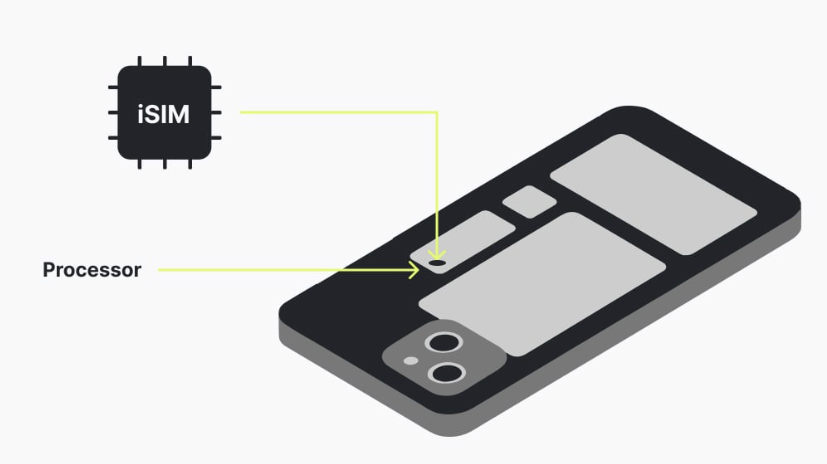
This tech brings the usual subscriber identity module stuff into the SoC. It uses a trusted execution environment, which is in all modern processors. Basically, it's a crystal inside the main processor that's key for authentication and storing login info. The data is shared inside this secure environment through internal channels, not external interfaces.
What is the Application of iSIM?
This solution is designed for small, low-power devices such as fitness trackers and industrial IoT devices. It is also widely used in agricultural sensors and logistics modules. It is essential wherever space on the PCB is limited and battery life must last for weeks or months.
Benefits and Downsides
Advantages: Zero footprint allows for smaller devices or, for example, larger batteries. Energy efficiency is also improved by eliminating the modem-SIM interface. Simpler equipment design.
Limitations: Certification by telecom operators is still lagging behind. The ecosystem is in its early stages of implementation and may take some time to roll out.
eSIM vs iSIM: Key Differences
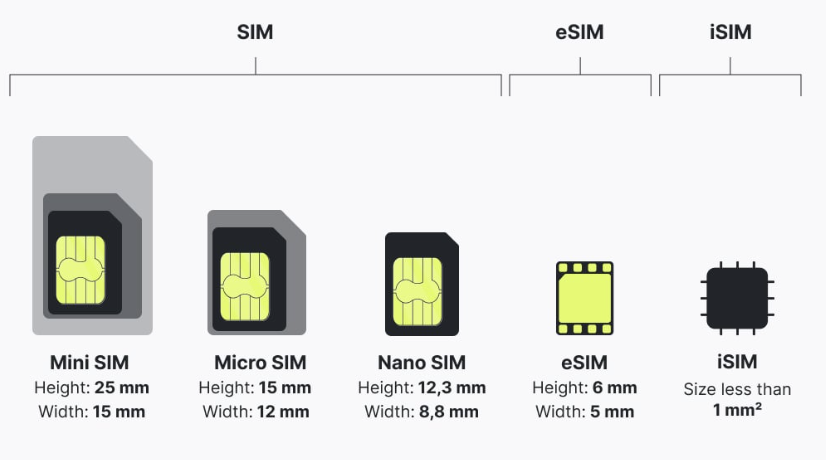
Below, we have briefly described the differences between the two architectural solutions. They directly affect the design of the equipment, energy consumption, and, of course, safety.
Source: https://ohayu.com/blog/isim-vs-esim-comparison/
Hardware and Form
In the digital SIM version, we get a chip soldered onto the board. Integrated SIM completely eliminates this separate component, and all functions are implemented within the SoC crystal itself.
Power and Efficiency
The integrated SIM solution consumes less energy, as it eliminates the need for a special interface between the modem and the SIM card. The competitor requires its own power supply and interface and typically consumes 5-7 mA.
Security Model
Both options use tamper-proof components certified to similar standards (Common Criteria EAL4+ or higher). The embedded SIM chip is located on the board, so it can be desoldered, isolated, and probed or attacked via a side channel. To hack an integrated SIM, you need to decapitate the main processor and probe the internal layers, which requires laboratory equipment and special knowledge.
Manufacturing and Supply Chain
Digital SIM adds an assembly step, and you also need a chip supplier and inventory management. The alternative simplifies this process: there is one less component to store and install. However, this ties you to specific microchip suppliers.
Ecosystem Maturity
Today, embedded SIM is widely supported by many carriers and devices. Integrated SIM works from a technical standpoint, but providers are not yet ready to implement it.
eSIM vs iSIM: Which One Fits Your Use Case?
The right decision depends entirely on your goals and requirements. It is also worth considering current compatibility, which is the main criterion here.
Choose Embedded SIM if
- You're looking for broad carrier compatibility. Support for this option is available in over 200 countries.
- There is a necessity to frequently switch between profiles in different regions, for example, when traveling.
- You want reliable, large-scale remote configuration with proven tools and platforms that already manage millions of devices.
Choose iSIM if
- The device is compact or has limited battery life, such as sensors or trackers, where every millimeter counts.
- You carefully control the design of the equipment and can choose chipsets that integrate this technology.
- Physical protection against intrusion is crucial, and deeper integration justifies this compromise.
Is iSIM Replacing eSIM?
It is safe to say that no, this will not happen anytime soon. This is an evolutionary step, not a replacement for existing technology. They'll coexist for many years to come because each type of device has its own requirements.
Smartphones need flexibility, especially when it comes to choosing an operator, and the current digital SIM format copes well with this. A compact tracker, produced in large quantities, can afford to be more rigidly tied to a supplier in order to gain an advantage in size and energy consumption.
It is also essential to consider the ecosystem itself. It took almost ten years for the market to form, and new integrated technology will follow a similar path. Therefore, it is logical to expect that both standards will serve different segments rather than replacing each other.
Final Thoughts
Both technologies solve the problem of device identification in a mobile network. When comparing eSIM vs iSIM, the key difference is in their architecture: in the first case, it is a separate component, while in the second, the functionality is built directly into the processor.
One does not replace the other because the requirements for devices are different. In some cases, flexibility in connecting to operators is more important, while in others, size and power consumption are critical. Therefore, they coexist, covering different application scenarios.