
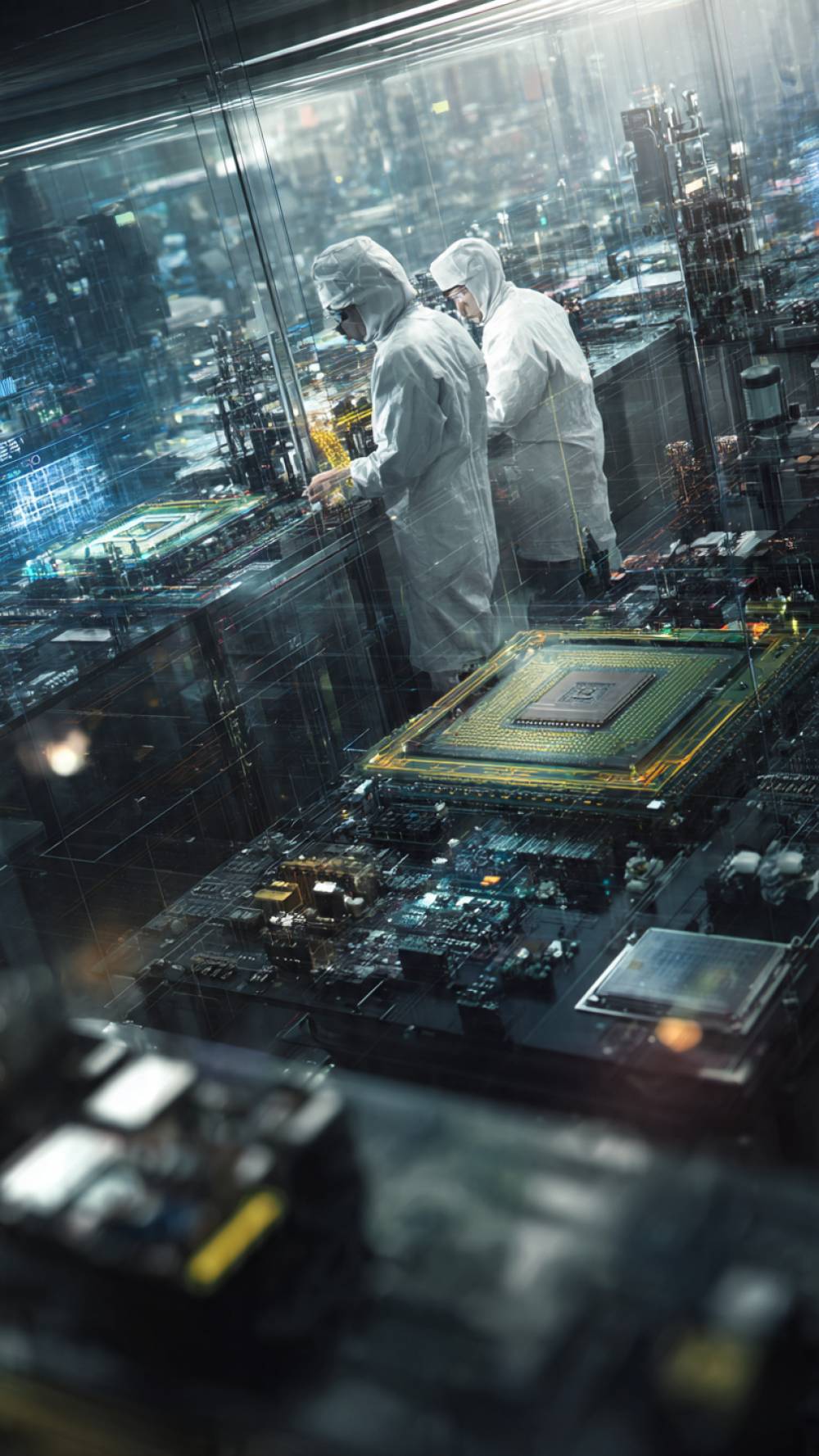
NVIDIA has become the most important company in the modern artificial intelligence (AI) revolution due to its dominance in AI chip development. Once known primarily for gaming graphics cards (GPUs), Nvidia has transformed into the backbone of global AI infrastructure, powering data centers, cloud computing platforms, autonomous vehicles, robotics, scientific research, and generative AI systems.
Today, nearly every major AI breakthrough—from large language models like ChatGPT to autonomous driving systems and scientific simulations—relies heavily on Nvidia GPUs and AI accelerators. The company’s chips are used by tech giants such as Microsoft, Google, Amazon, Meta, Tesla, and countless AI startups.
Nvidia’s dominance is not accidental; it is the result of long-term investment in parallel computing, deep learning infrastructure, software ecosystems, and strategic partnerships. Its platform, CUDA, and its advanced GPU architectures such as H100 and Blackwell have made Nvidia the central pillar of the AI economy.
This essay explores Nvidia’s role in AI chip development, its technological innovations, global influence, challenges, and detailed case studies that demonstrate its impact on the AI revolution.
Evolution of Nvidia: From Gaming to AI Infrastructure
Nvidia was founded in 1993 with a focus on graphics processing units (GPUs) for gaming and visual computing. For many years, its chips were used primarily in:
- Video games
- 3D rendering
- Animation
- Computer graphics
However, a major shift occurred in the 2010s when researchers discovered that GPUs were highly efficient for training deep neural networks due to their ability to perform parallel computations at massive scale.
This discovery positioned Nvidia at the center of the AI revolution.
The key turning point came when deep learning models like AlexNet (2012) demonstrated that GPUs could drastically accelerate AI training compared to traditional CPUs.
From that moment, Nvidia pivoted toward becoming an AI infrastructure company.
Nvidia’s Core AI Strategy
Nvidia’s AI dominance is built on three pillars:
1. GPU Hardware Leadership
Nvidia designs the world’s most advanced AI chips for training and inference.
2. Software Ecosystem (CUDA)
CUDA allows developers to run AI workloads efficiently on Nvidia GPUs.
3. Data Center AI Platforms
Nvidia builds full-stack AI systems for cloud providers and enterprises.
Together, these create a tightly integrated AI ecosystem that is difficult for competitors to replicate.
Nvidia and the Global AI Infrastructure
Nvidia GPUs power the majority of AI workloads globally.
Key customers include:
- Microsoft Azure
- Google Cloud
- Amazon Web Services
- Meta AI
- OpenAI
- Tesla
- Anthropic
Nvidia chips are essential for:
- Training large language models
- Running generative AI systems
- Computer vision
- Robotics
- Scientific simulations
- Autonomous driving
The company’s dominance in AI chips has made it one of the most valuable technology companies in the world.
Nvidia GPU Architecture and AI Innovation
Nvidia’s AI chips are designed for parallel processing, enabling thousands of computations simultaneously.
Key architectures include:
- Volta (V100)
- Ampere (A100)
- Hopper (H100)
- Blackwell (B200 series)
Each generation significantly improves:
- AI training speed
- Energy efficiency
- Memory bandwidth
- Model scalability
The latest Blackwell architecture is designed specifically for trillion-parameter AI models and large-scale generative AI systems.
CUDA: The Secret Weapon
CUDA (Compute Unified Device Architecture) is Nvidia’s proprietary software platform that allows developers to use GPUs for general-purpose computing.
CUDA is a major reason for Nvidia’s dominance because:
- It locks developers into Nvidia’s ecosystem
- It provides optimized AI performance
- It supports nearly all AI frameworks (PyTorch, TensorFlow)
CUDA has become the “operating system of AI computing.”
Nvidia in the AI Data Center Revolution
Modern AI requires massive computing power, and Nvidia GPUs are at the center of AI data centers.
Nvidia provides:
- GPU clusters
- AI supercomputing systems
- Networking hardware (InfiniBand)
- AI software frameworks
Cloud providers rely heavily on Nvidia hardware to deliver AI services globally.
Case Study 1: Nvidia GPUs Powering OpenAI and ChatGPT
Background
OpenAI’s large language models, including ChatGPT, rely heavily on Nvidia GPU infrastructure for both training and inference.
Training GPT models requires:
- Thousands of GPUs
- High-performance distributed computing
- Massive energy resources
Nvidia GPUs such as A100 and H100 are central to this process.
Nvidia’s Role
Nvidia provides:
- High-performance AI chips
- CUDA software optimization
- Distributed AI training infrastructure
- GPU clusters for cloud providers
Microsoft Azure, which hosts OpenAI systems, uses Nvidia GPUs extensively.
Impact
1. AI Model Scale Expansion
Nvidia GPUs enabled the training of trillion-parameter models.
2. Faster AI Development
Training times for large models were reduced significantly.
3. Generative AI Boom
Nvidia hardware directly enabled the rise of ChatGPT and similar systems.
Significance
Without Nvidia GPUs, the current generative AI revolution would not be possible at its current scale.
This case study shows Nvidia as the foundational infrastructure behind modern AI systems.
Case Study 2: Nvidia and Autonomous Driving Systems (Tesla, Waymo, and Others)
Background
Autonomous driving requires real-time processing of massive data from cameras, sensors, and radar systems.
Nvidia provides AI chips specifically designed for automotive applications.
Nvidia Drive Platform
Nvidia Drive is an AI computing platform used in:
- Self-driving cars
- Robotaxis
- Driver assistance systems
- Autonomous trucks
It includes:
- AI processors
- Simulation software
- Deep learning frameworks
Tesla and Nvidia Relationship
Tesla initially used Nvidia GPUs for training AI systems before developing its own chips.
Nvidia still plays a role in:
- AI research infrastructure
- Simulation systems
- Industry benchmarking
Waymo and Other Companies
Companies like Waymo use Nvidia GPUs for:
- Machine learning training
- Simulation environments
- Perception systems
Impact
1. Safety Improvements
AI chips enable faster object detection and decision-making.
2. Faster Development
Autonomous vehicle testing is accelerated through simulation.
3. Industry Standardization
Nvidia became the default AI compute platform for automotive AI.
Significance
Nvidia is the backbone of autonomous mobility development worldwide.
Case Study 3: Nvidia Blackwell Chips and AI Supercomputing
Background
The Blackwell architecture represents Nvidia’s most advanced AI chip generation.
It is designed for:
- Large language models
- Multimodal AI systems
- AI agents
- Real-time inference at scale
Key Features
- Massive parallel processing
- Improved energy efficiency
- Higher memory bandwidth
- Faster interconnects between GPUs
Industry Adoption
Major cloud providers are adopting Blackwell systems for:
- AI model training
- Enterprise AI deployment
- Generative AI applications
Impact
1. Reduced AI Training Costs
Blackwell reduces the cost of training large models.
2. Scalability
Supports trillion-parameter models.
3. AI Acceleration
Improves speed of generative AI responses.
Significance
Blackwell chips represent the next stage of AI infrastructure evolution.
Nvidia and Cloud Computing Dominance
Nvidia is deeply integrated into cloud computing platforms.
Cloud providers rely on Nvidia for:
- AI workloads
- Machine learning services
- GPU computing instances
- Generative AI APIs
Without Nvidia GPUs, cloud AI services would not scale effectively.
Case Study 4: Microsoft Azure AI Infrastructure
Background
Microsoft Azure is one of Nvidia’s largest customers.
Azure uses Nvidia GPUs to power:
- OpenAI models
- Microsoft Copilot
- Enterprise AI services
Nvidia Contribution
- GPU clusters (H100, A100)
- AI training infrastructure
- High-speed networking hardware
Impact
1. Enterprise AI Expansion
Businesses worldwide use Azure AI powered by Nvidia chips.
2. Productivity Tools
Microsoft Copilot relies on GPU-accelerated AI.
3. Cloud Competition
Azure competes with AWS and Google Cloud using Nvidia infrastructure.
Significance
This partnership demonstrates Nvidia’s central role in enterprise AI ecosystems.
Nvidia and Scientific Research
Nvidia GPUs are widely used in:
- Climate modeling
- Drug discovery
- Genomics
- Physics simulations
- Astronomy
AI models in scientific research require large-scale computation that only GPU clusters can provide efficiently.
Case Study 5: Nvidia in Drug Discovery and Healthcare AI
Background
Pharmaceutical companies use Nvidia GPUs to accelerate drug discovery.
AI models simulate molecular structures and predict drug effectiveness.
Nvidia Tools Used
- GPU computing clusters
- AI simulation frameworks
- Deep learning models
Impact
1. Faster Drug Development
AI reduces drug discovery timelines from years to months.
2. Cost Reduction
Computational simulations reduce lab testing costs.
3. Precision Medicine
AI improves patient-specific treatment design.
Significance
Nvidia accelerates breakthroughs in global healthcare systems.
Economic Impact of Nvidia’s AI Chip Dominance
Nvidia’s influence extends across the global economy:
1. AI Industry Growth
Nvidia powers the entire generative AI ecosystem.
2. Cloud Computing Expansion
Cloud services depend heavily on Nvidia GPUs.
3. Startup Ecosystem
AI startups rely on Nvidia infrastructure.
4. Semiconductor Industry Transformation
Nvidia reshaped chip design toward AI optimization.
Challenges Facing Nvidia
Despite dominance, Nvidia faces challenges:
1. Supply Chain Constraints
High demand exceeds production capacity.
2. Competition
Companies such as AMD, Intel, and custom AI chips from Google and Amazon compete in AI hardware.
3. Geopolitical Risks
Export restrictions affect chip sales in certain regions.
4. Energy Consumption
AI chips require massive power, raising sustainability concerns.
Future of Nvidia in AI Development
Nvidia is expected to expand into:
- AI supercomputing platforms
- Robotics computing systems
- AI-native operating systems
- Quantum computing integration
- Autonomous systems infrastructure
The company aims to become the central computing platform for AI everywhere.
Conclusion
Nvidia has become the foundation of the global AI revolution through its leadership in GPU design, AI infrastructure, and deep learning systems. Its chips power nearly every major AI application, from ChatGPT to autonomous vehicles, healthcare research, cloud computing, and robotics.
The detailed case studies involving OpenAI, autonomous driving systems, Blackwell chips, Azure AI infrastructure, and healthcare simulations demonstrate Nvidia’s central role in shaping modern artificial intelligence.
Nvidia’s dominance is driven by its hardware innovation, CUDA software ecosystem, and strategic positioning in data centers worldwide. Despite growing competition and supply challenges, Nvidia remains the most important enabler of AI development globally.
As AI continues to expand into every industry, Nvidia is positioned to remain the core infrastructure powering the future of intelligence, automation, and digital transformation.




